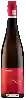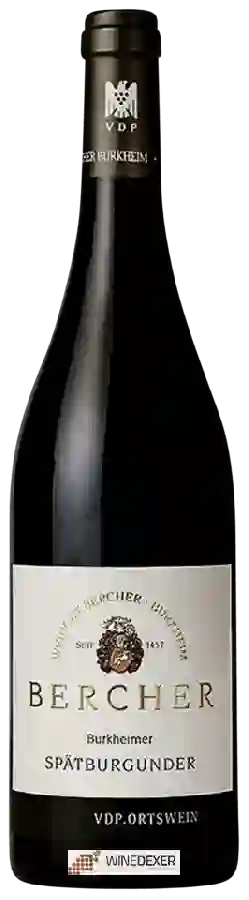
Weingut BercherBurkheimer Spätburgunder
 Red wine



In the mouth this red wine is a with a nice freshness.
This wine generally goes well with poultry, beef or veal.

Taste structure of the Burkheimer Spätburgunder from the Weingut Bercher
Light | Bold | |
Smooth | Tannic | |
Dry | Sweet | |
Soft | Acidic |
In the mouth the Burkheimer Spätburgunder of Weingut Bercher in the region of Baden is a with a nice freshness.
Food and wine pairings with Burkheimer Spätburgunder
Pairings that work perfectly with Burkheimer Spätburgunder



Original food and wine pairings with Burkheimer Spätburgunder

The Burkheimer Spätburgunder of Weingut Bercher matches generally quite well with dishes of beef, veal or game (deer, venison) such as recipes of traditional flemish carbonades, veal paupiettes with mushrooms or duck aiguillettes.
Details and technical informations about Weingut Bercher's Burkheimer Spätburgunder.
Discover the grape variety: Muscadelle
Aromatic, fruity whites with a tender palate, with intense aromas of muscat, white flowers, honey, candied citrus and floral notes (no genetic link to the muscat family). Minor component in the great botrytised dessert wines of Sauternes, Barsac, Cérons and Monbazillac, adding perfume and freshness. Also dry in Entre-Deux-Mers. Made as sumptuous fortified wines in Australia (Rutherglen Topaque). French variety from Bordeaux and the South-West.
Last vintages of this wine
The best vintages of Burkheimer Spätburgunder from Weingut Bercher are 0
Informations about the Weingut Bercher
The Weingut Bercher is one of of the world's great estates. It offers 69 wines for sale in the of Baden to come and discover on site or to buy online.

The wine region of Baden
German capital of Pinot Noir (Spätburgunder): silky, fine reds with notes of red fruits, cherry, undergrowth and sweet spices, melted tannins. Round Grauburgunder (Pinot Gris), lively Weissburgunder, supple Müller-Thurgau, mineral Riesling. Germany's 3rd region (15,000 ha) in Baden-Württemberg facing Alsace, one of the country's warmest climates, volcanic soils at the Kaiserstuhl. Cradle of modern great German reds, elegant and fine.
The word of the wine: Primeur (purchase in)
Purchase made shortly after the harvest and before the wine is ready for consumption.