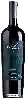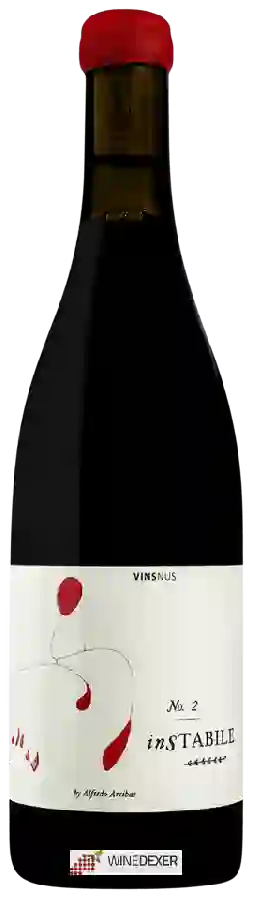
Winery VinsnusNo.2 InSTabile
 Red wine



In the mouth this red wine is a powerful with a nice balance between acidity and tannins.
This wine generally goes well with poultry, beef or game (deer, venison).

Taste structure of the No.2 InSTabile from the Winery Vinsnus
Light | Bold | |
Smooth | Tannic | |
Dry | Sweet | |
Soft | Acidic |
In the mouth the No.2 InSTabile of Winery Vinsnus in the region of Catalogne is a powerful with a nice balance between acidity and tannins.
Wine flavors and olphactive analysis




On the nose the No.2 InSTabile of Winery Vinsnus in the region of Catalogne often reveals types of flavors of earth, red fruit or black fruit and sometimes also flavors of floral.
Food and wine pairings with No.2 InSTabile
Pairings that work perfectly with No.2 InSTabile



Original food and wine pairings with No.2 InSTabile

The No.2 InSTabile of Winery Vinsnus matches generally quite well with dishes of beef, lamb or game (deer, venison) such as recipes of stuffed peppers, lamb keftas or rabbit with cider and apples.
Details and technical informations about Winery Vinsnus's No.2 InSTabile.
Discover the grape variety: Kokur Bely
Structured, aromatic whites with a pale to amber-golden colour, ample palate with fresh acidity, signature aromas of citrus, white flowers, yellow fruits and mineral notes. Also as historic sweet wines. Traditional component of dry white wines from Crimea (notably Sudak) and sweet wines from Massandra, contributing to historic regional blends of the Caucasus. Indigenous white variety from Ukraine and Russia, grown mainly in Crimea and the Caucasus.
Last vintages of this wine
The best vintages of No.2 InSTabile from Winery Vinsnus are 2017, 2016, 0
Informations about the Winery Vinsnus
The Winery Vinsnus is one of of the world's greatest estates. It offers 16 wines for sale in the of Priorat to come and discover on site or to buy online.

The wine region of Priorat
Mythical Catalan terroir, DOCa (Spain's summit alongside Rioja). Powerful, concentrated reds with signature notes of candied black fruits (blackberry, black cherry), graphite, schist, garrigue, cocoa and liquorice, firm tannins and a mineral palate strung by the "llicorella" (black schist and quartz forcing roots down to 20 m). Old vines of Garnacha (roundness) and Cariñena (Samsó, structure). Exceptional ageing.
The wine region of Catalogne
Cradle of Cava (~95% of Spanish output, traditional method): Macabeo, Xarel-lo, Parellada trilogy, fine fruity bubble. Quality peak in Priorat DOCa: dense, mineral reds on llicorella (schist), old-vine Garnacha and Cariñena with black fruit, garrigue notes, firm tannins. Also Penedès, fleshy Montsant, sunny Empordà, Costers del Segre. Mediterranean.
The word of the wine: Muscat blanc à petits grains
A white grape variety cultivated since antiquity on the shores of the Mediterranean, it is considered the noblest of the muscats. It is mainly used to make sweet wines, often from mutage. In France, it is the sole variety used in many natural sweet wines: muscat-de-frontignan, muscat-de-mireval, muscat-de-lunel, muscat-de-saint-jean-de-minervois, muscat-de-beaumes-de-venise, muscat-du-cap-corse. Combined with Muscat d'Alexandrie, it gives Muscat-de-Rivesaltes. It is also used to make sparkling white wines (clairette-de-die; moscato d'asti and asti spumante in Italy) and dry wines (alsace-muscat). Powerfully aromatic and complex, its wines evoke fresh grapes, roses, exotic fruits, citrus fruits and spices.