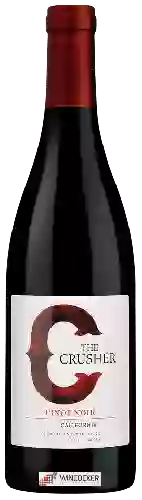
The Winery The Crusher of Clarksburg of California

Winery The Crusher
The winery offers 24 different wines
3.7


Note - 1Note - 1Note - 1Note - 0.5Note - 0
Its wines get an average rating of 3.7.
This estate is part of the Don Sebastiani & Sons.
It is ranked in the top 1 of the estates of California.
It is located in Clarksburg in the region of California

The Winery The Crusher is one of the largest wineries in the world. It offers 24 wines for sale in of Clarksburg to come and discover on site or to buy online.

Top Winery The Crusher wines

Looking for the best Winery The Crusher wines in Clarksburg among all the wines in the region? Check out our tops of the best red, white or effervescent Winery The Crusher wines. Also find some food and wine pairings that may be suitable with the wines from this area. Learn more about the region and the Winery The Crusher wines with technical and enological descriptions.

The top red wines of Winery The Crusher

Food and wine pairings with a red wine of Winery The Crusher

How Winery The Crusher wines pair with each other generally quite well with dishes of beef, veal or game (deer, venison) such as recipes of venison stew with red wine, ardéchoise fly or rabbit with mushrooms.

Organoleptic analysis of red wines of Winery The Crusher

On the nose the red wine of Winery The Crusher. often reveals types of flavors of cherry, oaky or smoke and sometimes also flavors of earthy, blackberry or red fruit. In the mouth the red wine of Winery The Crusher. is a powerful with a nice balance between acidity and tannins.

The best vintages in the red wines of Winery The Crusher

  • 2015With an average score of 3.82/5
  • 2014With an average score of 3.78/5
  • 2013With an average score of 3.76/5
  • 2016With an average score of 3.74/5
  • 2017With an average score of 3.73/5
  • 2009With an average score of 3.71/5

The grape varieties most used in the red wines of Winery The Crusher.

  • Cabernet Sauvignon
  • Pinot Noir
  • Petite Sirah
  • Merlot
  • Tempranillo
  • Zinfandel

Discovering the wine region of Clarksburg

The wine region of Clarksburg is located in the region of Yolo County of Central Valley of United States. Wineries and vineyards like the Domaine Jeff Runquist or the Domaine Bogle produce mainly wines red, white and pink. The most planted grape varieties in the region of Clarksburg are Chenin blanc, Chardonnay and Cabernet-Sauvignon, they are then used in wines in blends or as a single variety. On the nose of Clarksburg often reveals types of flavors of earthy, honey or apricot and sometimes also flavors of lemon, pear or honeysuckle.

In the mouth of Clarksburg is a powerful with a nice freshness. We currently count 143 estates and châteaux in the of Clarksburg, producing 324 different wines in conventional, organic and biodynamic agriculture. The wines of Clarksburg go well with generally quite well with dishes of beef, lamb or game (deer, venison).

The top white wines of Winery The Crusher

Food and wine pairings with a white wine of Winery The Crusher

How Winery The Crusher wines pair with each other generally quite well with dishes of pork, rich fish (salmon, tuna etc) or vegetarian such as recipes of ham with leek fondue, salmon cannelloni or cream and tuna quiche.

Organoleptic analysis of white wines of Winery The Crusher

On the nose the white wine of Winery The Crusher. often reveals types of flavors of non oak, microbio or oak and sometimes also flavors of tropical fruit, citrus fruit or tree fruit. In the mouth the white wine of Winery The Crusher. is a powerful with a nice freshness.

The best vintages in the white wines of Winery The Crusher

  • 2018With an average score of 3.80/5
  • 2013With an average score of 3.71/5
  • 2015With an average score of 3.65/5
  • 2012With an average score of 3.57/5
  • 0With an average score of 3.52/5
  • 2017With an average score of 3.50/5

The grape varieties most used in the white wines of Winery The Crusher.

  • Chardonnay
  • Sauvignon Blanc
  • Viognier

Discover the grape variety: Zinfandel

From Croatia where it is called crljenak kastelanski or pribidrag. According to genetic analyses carried out by Professor Carole Meredith of California University in Davis (United States), it is related to the Croatian plavac mali and Zinfandel. It is also found in South Africa, New Zealand, Chile, Brazil, Germany, Bulgaria, Albania, Italy under the name of Primitivo, Malta, Greece, Portugal and to some extent in Croatia. In the United States (California), it is one of the most widely planted grape varieties, having been introduced in the 1830s well before Primitivo. In France, it is registered in the official catalogue of vine varieties on the A1 list under the name Primitivo.

The top pink wines of Winery The Crusher

Food and wine pairings with a pink wine of Winery The Crusher

How Winery The Crusher wines pair with each other generally quite well with dishes of veal, pork or game (deer, venison) such as recipes of sauté of veal with tomato, breton galette with buckwheat flour or ramen (noodle) soup.

The best vintages in the pink wines of Winery The Crusher

  • 0With an average score of 3.80/5
  • 2012With an average score of 3.50/5

The grape varieties most used in the pink wines of Winery The Crusher.

  • Pinot Noir

The word of the wine: Bite

Said of a wine with exacerbated acidity.

Discover other wineries and winemakers neighboring the Winery The Crusher

Planning a wine route in the of Clarksburg? Here are the wineries to visit and the winemakers to meet during your trip in search of wines similar to Winery The Crusher.

Discover the grape variety: Pinot noir

Pinot noir is an important red grape variety in Burgundy and Champagne, and its reputation is well known! Great wines such as the Domaine de la Romanée Conti elaborate their wines from this famous grape variety, and make it a great variety. When properly vinified, pinot noit produces red wines of great finesse, with a wide range of aromas depending on its advancement (fruit, undergrowth, leather). it is also the only red grape variety authorized in Alsace. Pinot Noir is not easily cultivated beyond our borders, although it has enjoyed some success in Oregon, the United States, Australia and New Zealand.