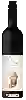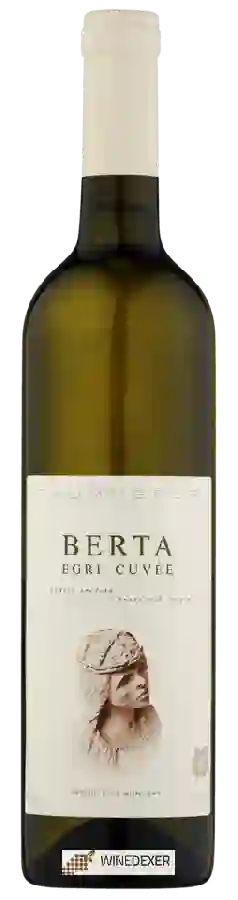
Winery ThummererBerta Egri Cuvée
 White wine


This wine generally goes well with
Wine flavors and olphactive analysis




On the nose the Berta Egri Cuvée of Winery Thummerer in the region of Eger often reveals types of flavors of vegetal, oak or tree fruit and sometimes also flavors of citrus fruit.
Details and technical informations about Winery Thummerer's Berta Egri Cuvée.
Discover the grape variety: Diolinoir
Intraspecific cross between robin noir and pinot noir obtained in 1970 by André Jacquinet of the Swiss Federal Research Station Agroscope Changins-Wadenswil (Switzerland).
Last vintages of this wine

The best vintages of Berta Egri Cuvée from Winery Thummerer are 2009, 2015, 2011, 2014 and 0.
Informations about the Winery Thummerer
The Winery Thummerer is one of of the world's great estates. It offers 59 wines for sale in the of Eger to come and discover on site or to buy online.

The wine region of Eger
Eger, in northeastern Hungary, is a wine region best known for its Egri Bikavér wine, popularly known as "Bull's Blood". Although Sweet, white Tokaji remains unrivaled as Hungary's most famous wine overall, Bikavér (Bull's Blood) is surely the country's most famous red. The style – a Complex blend of several dark-skinned grapes – was first made in the late 19th Century, in Szekszard (200 kilometers/130 miles southwest of Eger). It rose to international fame in the 1970s, when the state-owned Egervin winery monopolized production of the style, and successfully promoted it on export markets.
The word of the wine: Bordeaux futures
Bordeaux wines are expected 2 to 3 years before bottling. In the spring following the harvest, the wines are offered by the châteaux to the Bordeaux wine merchants via the brokers.