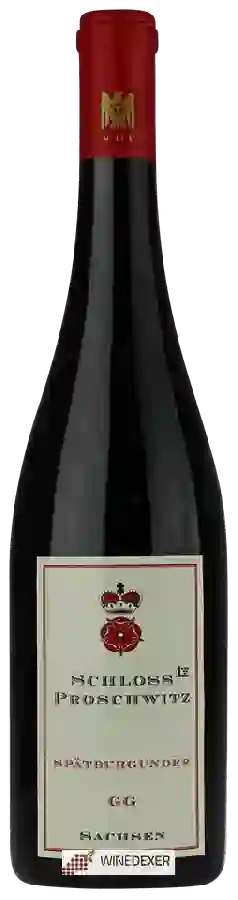
Weingut Schloss ProschwitzSpätburgunder GG
 Red wine


In the mouth this red wine is a with a nice freshness.
This wine generally goes well with poultry, beef or veal.
The Spätburgunder GG of the Weingut Schloss Proschwitz is in the top 40 of wines of Sachsen.

Taste structure of the Spätburgunder GG from the Weingut Schloss Proschwitz
Light | Bold | |
Smooth | Tannic | |
Dry | Sweet | |
Soft | Acidic |
In the mouth the Spätburgunder GG of Weingut Schloss Proschwitz in the region of Sachsen is a with a nice freshness.
Wine flavors and olphactive analysis


On the nose the Spätburgunder GG of Weingut Schloss Proschwitz in the region of Sachsen often reveals types of flavors of oak, red fruit.
Food and wine pairings with Spätburgunder GG
Pairings that work perfectly with Spätburgunder GG



Original food and wine pairings with Spätburgunder GG

The Spätburgunder GG of Weingut Schloss Proschwitz matches generally quite well with dishes of beef, veal or game (deer, venison) such as recipes of spanish stew (cocido), veal tagine with potatoes and olives or casserons in the country style.
Details and technical informations about Weingut Schloss Proschwitz's Spätburgunder GG.
Discover the grape variety: Muscat de Saint Vallier
Table grape with long clusters and golden berries with thin skin and muscat flesh, featuring a characteristic aromatic sweet flavour (rose, fresh grape). Very rarely vinified. Grown for fresh consumption in south-eastern France, appreciated for its typical muscat flavour and good shelf life. French white table grape variety obtained around 1922 in Saint-Vallier (Drôme), a muscat crossing.
Last vintages of this wine
The best vintages of Spätburgunder GG from Weingut Schloss Proschwitz are 0
Informations about the Weingut Schloss Proschwitz
The Weingut Schloss Proschwitz is one of of the world's great estates. It offers 49 wines for sale in the of Sachsen to come and discover on site or to buy online.

The wine region of Sachsen
The northernmost and one of the smallest German wine regions (507 ha), the Elbe valley on loess and granite. Lively, mineral whites largely dominate (81%). Signature Müller-Thurgau with signature notes of light muscat, green apple, white flowers and a citrus touch, supple palate. Taut, chiselled Riesling (lemon, peach), round Weißburgunder (pear, almond), ample Grauburgunder, rare aromatic Goldriesling.
The word of the wine: AOC
Appellation d'origine contrôlée. The most prestigious category of French wines created in the 1930s on the basis of quality criteria defined by a geographical delimitation, a chosen grape variety and precise production rules.