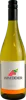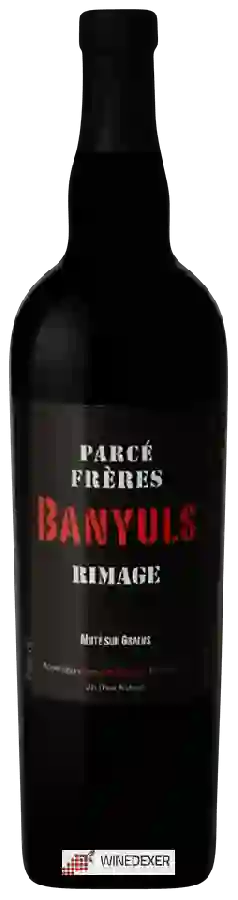
Winery Parcé FrèresBanyuls Rimage
 Natural sweet wine


This wine generally goes well with beef and mature and hard cheese.
Wine flavors and olphactive analysis

Food and wine pairings with Banyuls Rimage
Pairings that work perfectly with Banyuls Rimage


Original food and wine pairings with Banyuls Rimage
The Banyuls Rimage of Winery Parcé Frères matches generally quite well with dishes of beef or mature and hard cheese such as recipes of boeuf lôc lac (cambodia) or melt-in-the-mouth omelette with tomatoes, asparagus and comté.
Details and technical informations about Winery Parcé Frères's Banyuls Rimage.
Discover the grape variety: Souvignier gris
Interspecific cross between Cabernet Sauvignon and Bronner obtained in 1983 by Norbert Becker in Freiburg (Germany). A resistance gene has been identified to oidium, no gene to mildew. It can be found in Germany, but also in Belgium, the Netherlands, Italy, ... and in France.
Last vintages of this wine
The best vintages of Banyuls Rimage from Winery Parcé Frères are 2015
Informations about the Winery Parcé Frères
The Winery Parcé Frères is one of of the world's greatest estates. It offers 42 wines for sale in the of Banyuls to come and discover on site or to buy online.

The wine region of Banyuls
Banyuls wines come from the South-eastern Part of Roussillon, in the south of France, in the lower Pyrenees, a few kilometres from the Spanish border. These naturally Sweet wines are consumed both as an aperitif and as a dessert. They come in a wide range of hues, from GoldenGreen (Banyuls Blanc) to Amber (Banyuls Ambré) to the intense garnet of the standard Banyuls Rouge. Unusually among the natural sweet wines of France, all Banyuls wines are made primarily from Grenache grapes of various colors.
The wine region of Languedoc-Roussillon
Languedoc (formerly Coteaux du Languedoc) is a key appellation used in the Languedoc-Roussillon wine region of southern France. It covers Dry table wines of all three colors (red, white and rosé) from the entire region, but leaves Sweet and Sparkling wines to other more specialized appellations. About 75% of all Languedoc wines are red, with the remaining 25% split roughly down the middle between whites and rosés. The appellation covers most of the Languedoc region and almost a third of all the vineyards in France.
The word of the wine: Balance
Harmony of the different organoleptic elements of a wine. The balance is linked to the typicity of each wine. The sweetness of a sweet wine is an element of its balance, whereas a Sancerre or a Chablis will be asked to be lively and dry.