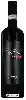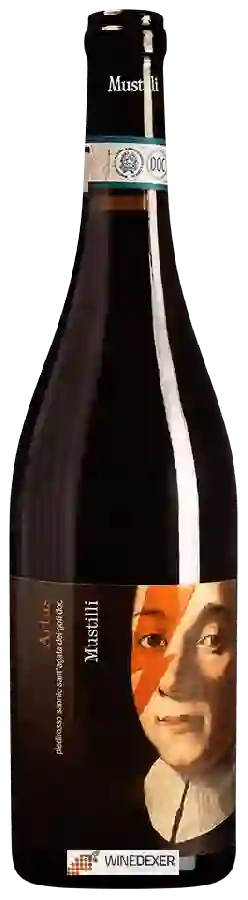
Winery MustilliArtus
 Red wine



In the mouth this red wine is a powerful.
This wine generally goes well with beef, lamb or pasta.

Taste structure of the Artus from the Winery Mustilli
Light | Bold | |
Smooth | Tannic | |
Dry | Sweet | |
Soft | Acidic |
In the mouth the Artus of Winery Mustilli in the region of Campania is a powerful.
Food and wine pairings with Artus
Pairings that work perfectly with Artus



Original food and wine pairings with Artus
The Artus of Winery Mustilli matches generally quite well with dishes of beef, pasta or lamb such as recipes of adapted vietnamese fondue, pasta stuffed with meat or sausage and vegetable risotto with cookéo.
Details and technical informations about Winery Mustilli's Artus.
Discover the grape variety: Frontenac
Deeply coloured, fruity reds with a dense purple robe, supple tannins and firm acidity, with intense aromas of black cherry, plum, blackcurrant, blackberry and spicy notes. Also made as expressive rosés and ice wines (Frontenac Gris). An extremely cold-hardy interspecific variety (down to -35°C on the vine), producing wines in cold US states (Minnesota, Wisconsin, Vermont) and Canada (Quebec). Created in 1996 at the University of Minnesota.
Last vintages of this wine
The best vintages of Artus from Winery Mustilli are 2016, 0, 2015, 2017
Informations about the Winery Mustilli
The Winery Mustilli is one of of the world's greatest estates. It offers 21 wines for sale in the of Campania to come and discover on site or to buy online.

The wine region of Campania
Cradle of southern Italy's great wines on volcanic soils. Majestic Aglianico in red: structured, deep and tannic with notes of black cherry, candied plum, leather and spices, sublimated in age-worthy Taurasi DOCG, the "Barolo of the south". Identity whites of Irpinia: opulent Fiano di Avellino (honey, hazelnut), mineral iodine Greco di Tufo, aromatic Falanghina (peach, flowers). Also supple Piedirosso.
The word of the wine: Terroir
Strictly speaking, the notion of terroir corresponds to the geological characteristics of a vineyard. However, when we talk about terroir, we take into account the soil, the climate (even the microclimate), the flora, the fauna, and the human factor that characterizes the practices that make up the art of the craft.