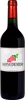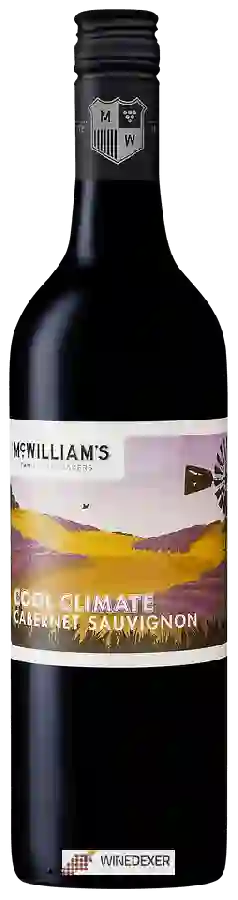
Winery McWilliam'sCabernet Sauvignon Cool Climate
 Red wine


In the mouth this red wine is a powerful with a nice balance between acidity and tannins.
This wine generally goes well with poultry, beef or lamb.
Taste structure of the Cabernet Sauvignon Cool Climate from the Winery McWilliam's
Light | Bold | |
Smooth | Tannic | |
Dry | Sweet | |
Soft | Acidic |
In the mouth the Cabernet Sauvignon Cool Climate of Winery McWilliam's in the region of Australie du Sud-Est is a powerful with a nice balance between acidity and tannins.
Food and wine pairings with Cabernet Sauvignon Cool Climate
Pairings that work perfectly with Cabernet Sauvignon Cool Climate



Original food and wine pairings with Cabernet Sauvignon Cool Climate
The Cabernet Sauvignon Cool Climate of Winery McWilliam's matches generally quite well with dishes of beef, lamb or poultry such as recipes of savoyard matafans, lamb tagine with prunes and dried fruits or pumpkin and bacon pie.
Details and technical informations about Winery McWilliam's's Cabernet Sauvignon Cool Climate.
Discover the grape variety: Cabernet-Sauvignon
Cabernet-Sauvignon noir is a grape variety that originated in France (Bordeaux). It produces a variety of grape specially used for wine making. It is rare to find this grape to eat on our tables. This variety of grape is characterized by small bunches, and small grapes. Cabernet-Sauvignon noir can be found in many vineyards: South-West, Loire Valley, Languedoc & Roussillon, Cognac, Bordeaux, Armagnac, Rhone Valley, Provence & Corsica, Savoie & Bugey, Beaujolais.
Last vintages of this wine
The best vintages of Cabernet Sauvignon Cool Climate from Winery McWilliam's are 2013, 0
Informations about the Winery McWilliam's
The Winery McWilliam's is one of of the world's great estates. It offers 85 wines for sale in the of Australie du Sud-Est to come and discover on site or to buy online.

The wine region of Australie du Sud-Est
South East Australia is a geographical indication (GI) covering the entire south-eastern third of Australia. The western boundary of this area extends 2,000 kilometres (1,250 miles) across the Australian continent from the Pacific coast of Queensland to the Southern Ocean coast of South Australia. This vast wine 'super zone' effectively encompasses all the major Australian wine regions outside Western Australia. Rainforest, mountain ranges, scrubland, desert and Dry riverbeds occupy the majority of the land in the South East Australian area.
The word of the wine: Ugni blanc
White grape variety of Italian origin, and the main white variety grown in France. Its large bunches give fine, light and lively wines, suitable for distillation: today it is the main variety for making cognac and armagnac. Ugni blanc, which is a little richer in alcohol when grown in Mediterranean regions, is used in the blending of the Provence and Corsica appellations, often in association with other grape varieties that bring aromas and structure, such as clairette, grenache blanc or sauvignon. Ugni blanc is also used, on a secondary basis, in the production of certain white wines in Gironde (AOC Bordeaux, Entre-deux-Mers, etc.).