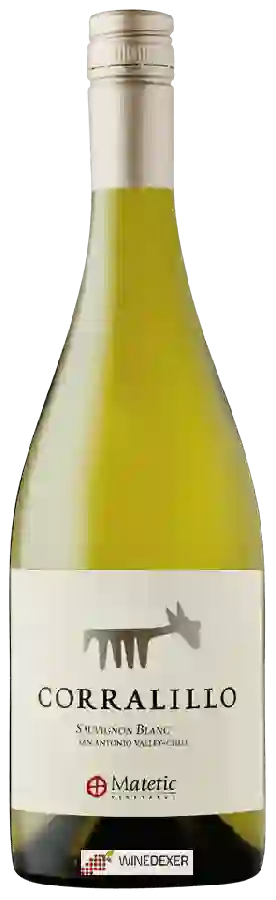
Winery MateticCorralillo Sauvignon Blanc
 White wine



In the mouth this white wine is a powerful with a nice freshness.
This wine generally goes well with vegetarian, shellfish or goat cheese.
The Corralillo Sauvignon Blanc of the Winery Matetic is in the top 30 of wines of San Antonio Valley.
Taste structure of the Corralillo Sauvignon Blanc from the Winery Matetic
Light | Bold | |
Dry | Sweet | |
Soft | Acidic |
In the mouth the Corralillo Sauvignon Blanc of Winery Matetic in the region of Aconcagua is a powerful with a nice freshness.
Wine flavors and olphactive analysis






On the nose the Corralillo Sauvignon Blanc of Winery Matetic in the region of Aconcagua often reveals types of flavors of pineapple, cream or grapefruit and sometimes also flavors of oaky, tropical or citrus.
Food and wine pairings with Corralillo Sauvignon Blanc
Pairings that work perfectly with Corralillo Sauvignon Blanc


Original food and wine pairings with Corralillo Sauvignon Blanc
The Corralillo Sauvignon Blanc of Winery Matetic matches generally quite well with dishes of shellfish, vegetarian or goat cheese such as recipes of mie goreng, ham and comté quiche or chicken and courgette pie.
Details and technical informations about Winery Matetic's Corralillo Sauvignon Blanc.
Discover the grape variety: Calitor
Calitor is a black grape variety of Provençal origin that is not widely grown in France. It is only cultivated on a little more than a hundred hectares in total. The main characteristic of this variety is its bent stalk. Its adult leaves have 5 lobes and angular teeth. The leaf blade is both pubescent and downy. The young leaves have a pinkish tinge, especially in autumn. They are also downy. The tip of the calitor branch is cottony. Calitor is a recommended grape variety in the departments of Vaucluse and Var and is authorized in others such as Gard, Drôme and Ardèche. It has two variants, namely the grey calitor and the white calitor. The calitor is matured only 35 days after the chasselas but it is very productive. It appreciates hot and dry soils. This variety is resistant to oidium, but it remains sensitive to grey rot and mildew. Calitor produces a light, low-alcohol wine with little colour.
Last vintages of this wine
The best vintages of Corralillo Sauvignon Blanc from Winery Matetic are 2019, 2017, 2016, 2018 and 2014.
Informations about the Winery Matetic
The Winery Matetic is one of of the world's great estates. It offers 28 wines for sale in the of San Antonio Valley to come and discover on site or to buy online.

The wine region of San Antonio Valley
San Antonio Valley is a small wine region in Chile, located near the Pacific coast 80km (50 miles) as the crow flies west of the capital, Central-valley/maipo-valley/santiago">Santiago. A relatively recent addition to the Chilean national Vineyard, the region stands out as being able to produce quality Pinot Noir along with internationally respected white wines, including Sauvignon Blanc and Chardonnay. The province for which the valley is named surrounds the coastal city of San Antonio, 90km (55 miles) west of central Santiago and just South of Casablanca Valley. Vineyards lie on the rolling hills that characterize the region, often within 32km (20 miles) of the Pacific Ocean that forms San Antonio's western edge.
The wine region of Aconcagua
The Aconcagua Valley is a wine-producing region of Chile, located 100 kilometres (60 miles) North of the capital, Santiago. It was Long thought that this hot, Dry valley was not suitable for growing wine grapes but the quality of the region's modern-day Cabernet Sauvignon, Syrah and Merlot has robustly reversed this opinion. The Aconcagua Valley is found on the east side of the Aconcagua region, one of Chile's four main producing regions. It takes its name from the eponymous river flowing through it, which in turn is named after the 6,960 meter-high (2,284ft) Mt.
The word of the wine: Oenologist
Specialist in wine-making techniques. It is a profession and not a passion: one can be an oenophile without being an oenologist (and the opposite too!). Formerly attached to the Faculty of Pharmacy, oenology studies have become independent and have their own university course. Learning to make wine requires a good chemical background but also, increasingly, a good knowledge of the plant. Some oenologists work in laboratories (analysis). Others, the consulting oenologists, work directly in the properties.