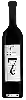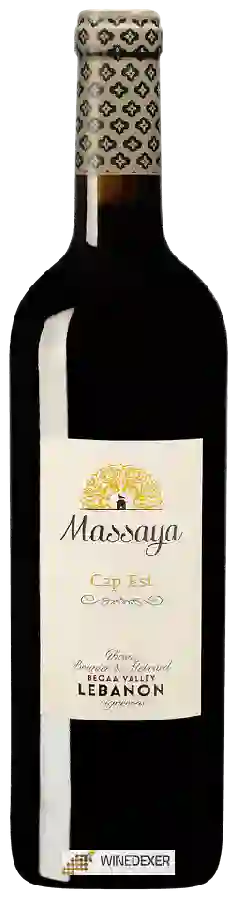
Winery MassayaCap Est
 Red wine


This wine generally goes well with beef and mature and hard cheese.
The Cap Est of the Winery Massaya is in the top 60 of wines of Lebanon and in the top 40 of wines of Bekaa Valley.

Wine flavors and olphactive analysis



On the nose the Cap Est of Winery Massaya in the region of Bekaa Valley often reveals types of flavors of oaky, earthy or red fruit and sometimes also flavors of vanilla, leather or raspberry.
Food and wine pairings with Cap Est
Pairings that work perfectly with Cap Est


Original food and wine pairings with Cap Est
The Cap Est of Winery Massaya matches generally quite well with dishes of beef or mature and hard cheese such as recipes of lomo saltado or comté cheese cake-flan.
Details and technical informations about Winery Massaya's Cap Est.
Discover the grape variety: Mourvèdre
Powerful, deep reds with firm tannins and dense texture, showing aromas of blackberry, leather, garrigue, black pepper, liquorice and animal notes (game, forest floor) with age. Star of Bandol AOC as a single variety and pillar of Châteauneuf-du-Pape, Gigondas and Costières blends. Also in GSM in Languedoc and Australia. A late-ripening variety of Spanish origin (Mataró/Monastrell).
Last vintages of this wine

The best vintages of Cap Est from Winery Massaya are 2017, 2013, 2015
Informations about the Winery Massaya
The Winery Massaya is one of of the world's greatest estates. It offers 12 wines for sale in the of Bekaa Valley to come and discover on site or to buy online.

The wine region of Bekaa Valley
Lebanese high-altitude valley (~1,000 m), ~6,000 years of winegrowing, ~90% of the country's wine. Complex, age-worthy reds with signature notes of black cherry, blackberry, garrigue, leather, cedar, oriental spices and a balsamic touch, firm tannins and long ageing — Cabernet for backbone, supple Cinsault, dense Carignan, fruity Grenache, peppery Syrah. Native whites Merwah and Obaideh, taut and mineral. Iconic Chateau Musar.
The word of the wine: pH
Short for "hydrogen potential", the pH is a parameter that defines whether a medium is acidic or basic. A high pH gives a soft wine, a very low pH translates into a wine that is too acidic.