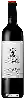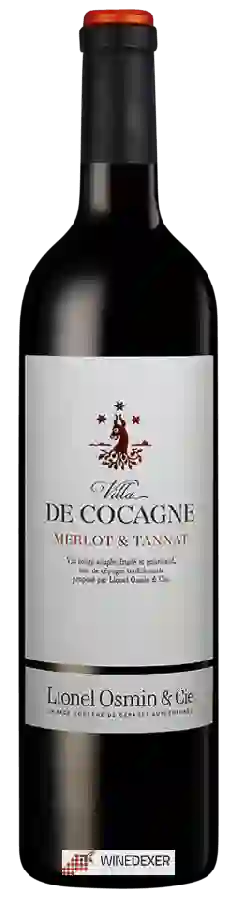
Winery Lionel Osmin & CieVilla de Cocagne
 Red wine



This wine is a blend of 2 varietals which are the Tannat and the Merlot.
This wine generally goes well with beef, game (deer, venison) or lamb.
Wine flavors and olphactive analysis

Food and wine pairings with Villa de Cocagne
Pairings that work perfectly with Villa de Cocagne



Original food and wine pairings with Villa de Cocagne


The Villa de Cocagne of Winery Lionel Osmin & Cie matches generally quite well with dishes of beef, lamb or game (deer, venison) such as recipes of beef colombo bourguignon style, saddle of lamb with herbs or duck breast with honey.
Details and technical informations about Winery Lionel Osmin & Cie's Villa de Cocagne.
Discover the grape variety: Tannat
Tannat is a red grape variety from Béarn which belongs to the cotoïdes family. Present in several vineyards of France, it occupies nearly 3,000 ha. Its leaves are reddish with tan patches. Its bunches are either of normal size or larger. Its berries have a thin skin and are rounded. Its foliage has a swarthy appearance. This variety must be pruned long because it is vigorous. It likes sandy and gravelly soils. Tannat is often exposed to leafhoppers and mites. It is also somewhat susceptible to grey rot. It has 11 approved clones, including 474, 717 and 794. Once mature, this variety produces acidic, fruity, tannic, acidic and full-bodied wines. Various aromas emerge, notably tobacco, cinnamon and exotic wood. Tannat is rarely used alone. It is combined with iron-servadou to obtain a fruitier taste or with cabernet sauvignon to be more rounded.
Last vintages of this wine
The best vintages of Villa de Cocagne from Winery Lionel Osmin & Cie are 2016, 2018, 2013, 2012 and 2014.
Informations about the Winery Lionel Osmin & Cie
The Winery Lionel Osmin & Cie is one of of the world's great estates. It offers 88 wines for sale in the of Vin de Pays to come and discover on site or to buy online.

The wine region of Vin de Pays
Vin de Pays (VDP), the French national equivalent of PGI (Protected Geographical Indication) at the European level, is a quality category of French wines, positioned between Vin de Table (VDT) and Appellation d'Origine Contrôlée (AOC). This layer of the French appellation system was initially introduced in September 1968 by the INAO, the official appellation authority. It underwent several early revisions in the 1970s, followed by substantial changes in September 2000 and again in 2009, when all existing VDT titles were automatically registered with the European Union as PGI. Producers retain the choice of using either the VDP or PGI titles on their labels, or both - in the form "IGP-Vin de Pays".
The wine region of Pays d'Oc
Pays d'Oc is the PGI for red, white and rosé wines that are produced over a wide area of the southern coast of France. The PGI catchment area corresponds roughly to the Languedoc-roussillon">Languedoc-Roussillon wine region, one of the largest wine regions in France. The area covers all wines that are not produced under the strict laws that govern AOC-level appellations in the regions: among them, Corbières, Minervois and the Languedoc appellation itself. The Pays d'Oc PGI is arguably the most important in France, producing the majority of the country's PGI wines.
The word of the wine: Ampélographie
Study of the vine, and more particularly the grape varieties.