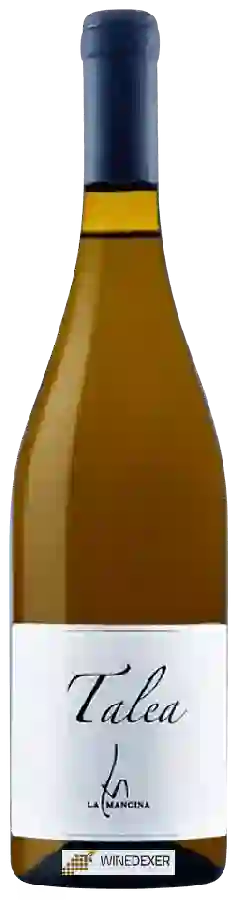
Winery La MancinaTalea
 White wine



In the mouth this white wine is a powerful with a nice freshness.
This wine generally goes well with lean fish, shellfish or mature and hard cheese.

Taste structure of the Talea from the Winery La Mancina
Light | Bold | |
Dry | Sweet | |
Soft | Acidic |
In the mouth the Talea of Winery La Mancina in the region of Emilia-Romagna is a powerful with a nice freshness.
Food and wine pairings with Talea
Pairings that work perfectly with Talea



Original food and wine pairings with Talea


The Talea of Winery La Mancina matches generally quite well with dishes of pasta, shellfish or mature and hard cheese such as recipes of spaghetti with garlic, clams in white wine or gratin comtois.
Details and technical informations about Winery La Mancina's Talea.
Discover the grape variety: Cabernet-Severnyi
Deep-coloured, fruity reds with a dark ruby colour, moderate tannins and a direct palate; signature aromas of red fruits (cherry, raspberry), gentle spices and herbal notes typical of disease-resistant hybrids. Early-ripening northern profile. Grown in Russia, Ukraine and Eastern Europe in extreme continental vineyards. Russian black hybrid obtained in 1959, involving Cabernet Sauvignon.
Last vintages of this wine
The best vintages of Talea from Winery La Mancina are 2011, 2009, 0, 2013 and 2012.
Informations about the Winery La Mancina
The Winery La Mancina is one of of the world's greatest estates. It offers 12 wines for sale in the of Emilia-Romagna to come and discover on site or to buy online.

The wine region of Emilia-Romagna
Kingdom of Lambrusco: fresh, fruity sparkling reds (blackberry, cherry, violet), from gourmet dry to convivial off-dry, perfect with local charcuterie. World's best-selling sparkling wine on the Emilia side (Sorbara, Grasparossa, Salamino). East, Romagna: supple fruity Sangiovese, Albana (Italy's 1st white DOCG, 1987) ample and almondy. Also red Gutturnio and white Pignoletto.
The word of the wine: Faded
Said of a wine that has lost its brilliance and depth. It can also be used to describe the nose of an old wine that has lost its aromatic freshness.