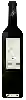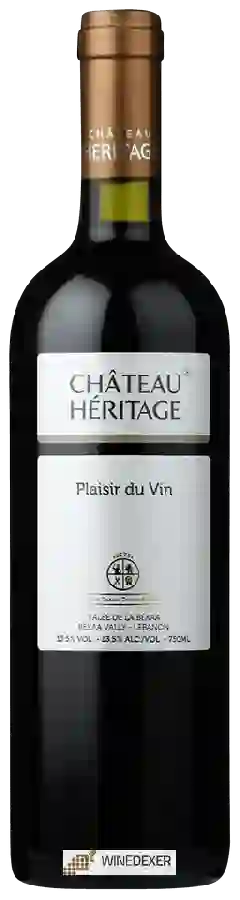
Château HeritagePlaisir du Vin Rouge
 Red wine



This wine is a blend of 3 varietals which are the Cabernet-Sauvignon, the Cinsault and the Syrah.
This wine generally goes well with poultry, beef or game (deer, venison).
The Plaisir du Vin Rouge of the Château Heritage is in the top 80 of wines of Lebanon and in the top 60 of wines of Bekaa Valley.

Wine flavors and olphactive analysis





On the nose the Plaisir du Vin Rouge of Château Heritage in the region of Bekaa Valley often reveals types of flavors of cherry, earthy or blackberry and sometimes also flavors of tobacco, vanilla or plum.
Food and wine pairings with Plaisir du Vin Rouge
Pairings that work perfectly with Plaisir du Vin Rouge



Original food and wine pairings with Plaisir du Vin Rouge



The Plaisir du Vin Rouge of Château Heritage matches generally quite well with dishes of beef, lamb or game (deer, venison) such as recipes of beef tagliata with truffle oil, trapper's barbecue or rabbit socks in gibelotte.
Details and technical informations about Château Heritage's Plaisir du Vin Rouge.
Discover the grape variety: Cabernet-Sauvignon
Structured, tannic reds, deeply coloured, with aromas of blackcurrant, blackberry, cedar, tobacco and graphite, underpinned by firm acidity and fine ageing potential. Cornerstone of the great Médoc estates (Pauillac, Saint-Estèphe, Saint-Julien) and signature of Napa Valley, Coonawarra and Maipo. The world's most planted red variety, a natural cross of Cabernet Franc x Sauvignon Blanc born in Bordeaux.
Last vintages of this wine
The best vintages of Plaisir du Vin Rouge from Château Heritage are 2008, 2021, 2019, 2018 and 2016.
Informations about the Château Heritage
The Château Heritage is one of of the world's greatest estates. It offers 19 wines for sale in the of Bekaa Valley to come and discover on site or to buy online.

The wine region of Bekaa Valley
Lebanese high-altitude valley (~1,000 m), ~6,000 years of winegrowing, ~90% of the country's wine. Complex, age-worthy reds with signature notes of black cherry, blackberry, garrigue, leather, cedar, oriental spices and a balsamic touch, firm tannins and long ageing — Cabernet for backbone, supple Cinsault, dense Carignan, fruity Grenache, peppery Syrah. Native whites Merwah and Obaideh, taut and mineral. Iconic Chateau Musar.
The word of the wine: Vineyard
Said of a wine with a certain alcoholic richness and clearly showing the characteristics that distinguish wine from other alcoholic beverages.