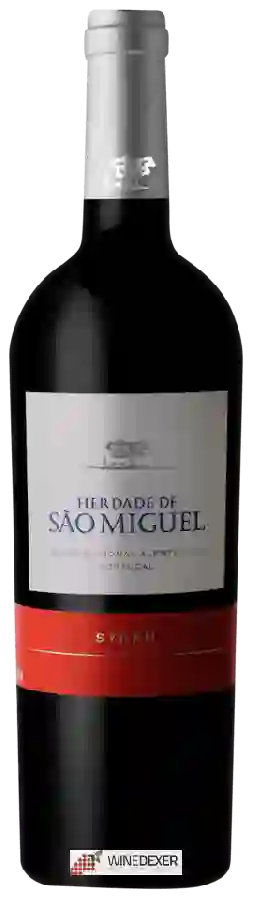
Winery Herdade de São MiguelSyrah
 Red wine



In the mouth this red wine is a powerful with a nice balance between acidity and tannins.
This wine generally goes well with poultry, beef or veal.

Taste structure of the Syrah from the Winery Herdade de São Miguel
Light | Bold | |
Smooth | Tannic | |
Dry | Sweet | |
Soft | Acidic |
In the mouth the Syrah of Winery Herdade de São Miguel in the region of Alentejano is a powerful with a nice balance between acidity and tannins.
Food and wine pairings with Syrah
Pairings that work perfectly with Syrah



Original food and wine pairings with Syrah

The Syrah of Winery Herdade de São Miguel matches generally quite well with dishes of beef, pasta or veal such as recipes of polish goulash, spaghetti with knackis or roast veal with chanterelles and cream.
Details and technical informations about Winery Herdade de São Miguel's Syrah.
Discover the grape variety: Regner
Aromatic, fruity whites best drunk young, with a pale golden robe, an ample palate with moderate acidity, and signature muscat aromas, exotic fruits (lychee), white flowers, and intense floral notes. Also produced as off-dry and sweet styles. Grown in Germany, England, and Luxembourg. A German white variety obtained in 1929 at Alzey by Georg Scheu (Luglienca bianca × Gamay).
Last vintages of this wine
The best vintages of Syrah from Winery Herdade de São Miguel are 2014, 2017, 2011, 0 and 2012.
Informations about the Winery Herdade de São Miguel
The Winery Herdade de São Miguel is one of of the world's great estates. It offers 24 wines for sale in the of Alentejano to come and discover on site or to buy online.

The wine region of Alentejano
Star of southern Portugal's great reds, sunny and opulent wines. Typical blends: round fruity Aragonez (Tempranillo), spicy Trincadeira, Touriga Nacional (black fruits, violet), deep teinturier Alicante Bouschet, juicy Castelão. Fleshy reds with notes of plum, black cherry, cocoa and sweet spices, melted tannins. Ample fresh Antão Vaz and Arinto whites.
The word of the wine: Old vines
There are no specific regulations governing the term "vieilles vignes". After 20 to 25 years, the yields stabilize and tend to decrease, the vines are deeply rooted, and the grapes that come from them give richer, more concentrated, more sappy wines, expressing with more nuance the characteristics of their terroir. It is possible to find plots of vines that claim to be a century old.