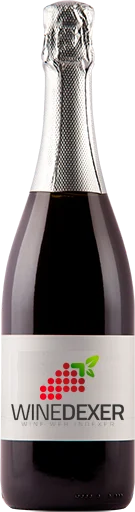
Winery Marks & SpencerLambrusco Reggiano Secco
 Sparkling wine


This wine generally goes well with
Details and technical informations about Winery Marks & Spencer's Lambrusco Reggiano Secco.
Discover the grape variety: Saint Pierre doré
Belonging to the Estaing wines, the Saint Pierre doré is also called Roussellou. With an average budding, this variety is presented in the form of full, winged, elongated and very large bunches, with pulpy, spherical and medium-sized berries. When ripe, the fruit is golden-white in colour, with bronze leaves, which may be three-lobed or whole. The red colour is also found on the internodes of its herbaceous branch. For best results, a fairly long pruning will suit the Saint Pierre Doré, which is not overly afraid of oidium or mildew, but more afraid of grey rot. The characteristics of the roussellou mean that it could play a major role in the production of sparkling wines. The vine does indeed give a very acidic taste, not very sweet and with low degree aromas. It has been noted that the extent of the vineyard recorded in 1958 is 123 Ha, to be reduced to 1 Ha in 1994 on the French territory.
Informations about the Winery Marks & Spencer
The Winery Marks & Spencer is one of wineries to follow in Reggiano.. It offers 455 wines for sale in the of Reggiano to come and discover on site or to buy online.

The wine region of Reggiano
The wine region of Reggiano is located in the region of Émilie-Romagne of Italy. Wineries and vineyards like the Domaine Piccini or the Domaine Bertolani produce mainly wines sparkling, red and sweet. The most planted grape varieties in the region of Reggiano are Ancellotta, Cabernet franc and Cabernet-Sauvignon, they are then used in wines in blends or as a single variety. On the nose of Reggiano often reveals types of flavors of cream, banana or black fruits and sometimes also flavors of black currant, cassis or mint.
The wine region of Emilia-Romagna
Romagna/emilia">Emilia-Romagna is a Rich and fertile region in Northern Italy, and one of the country's most prolific wine-producing regions, with over 58,000 hectares (143,320 acres) of vines in 2010. It is 240 kilometers (150 miles) wide and stretches across almost the entire northern Italian peninsula, sandwiched between Tuscany to the South, Lombardy and Veneto to the north and the Adriatic Sea to the east. Nine miles of Liguria is all that separates Emilia-Romagna from the Ligurian Sea, and its uniqueness as the only Italian region with both an east and west coast. Emilia-Romagna's wine-growing heritage dates back to the seventh century BC, making it one of the oldest wine-growing regions in Italy.
The word of the wine: Dress
Visual aspect of the wine. The colour is defined by its intensity, clarity, brilliance and colour, which indicate the level of evolution of the wine, thus giving an indication of its vintage.