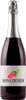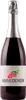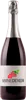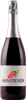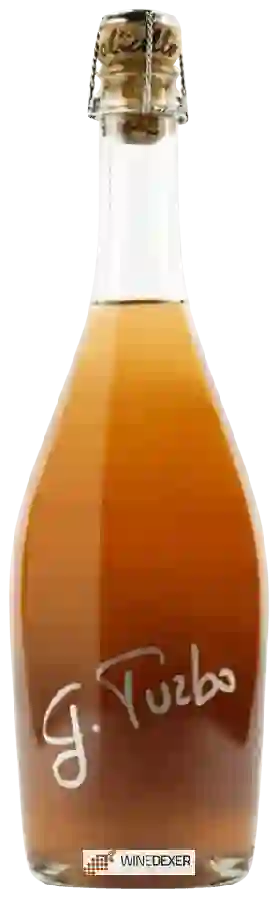
Winery FolicelloG. Turbo Sparkling Rosé
 Sparkling wine


This wine generally goes well with pork, poultry or rich fish (salmon, tuna etc).
Wine flavors and olphactive analysis

On the nose the G. Turbo Sparkling Rosé of Winery Folicello in the region of Emilia-Romagna often reveals types of flavors of citrus fruit.
Food and wine pairings with G. Turbo Sparkling Rosé
Pairings that work perfectly with G. Turbo Sparkling Rosé



Original food and wine pairings with G. Turbo Sparkling Rosé


The G. Turbo Sparkling Rosé of Winery Folicello matches generally quite well with dishes of pork, rich fish (salmon, tuna etc) or mature and hard cheese such as recipes of cabbage casserole, tunisian sandwich or 3 cheese ravioli gratin.
Details and technical informations about Winery Folicello's G. Turbo Sparkling Rosé.
Discover the grape variety: Limberger
Without much certainty, its origin would be German. It is a very old variety that has been cultivated for a long time in Germany, Austria, Italy, Croatia, Slovenia, the Czech Republic, Slovakia, Hungary, etc. Today, the Limberger is less and less multiplied. It is a direct descendant of the white gouais.
Last vintages of this wine
The best vintages of G. Turbo Sparkling Rosé from Winery Folicello are 0, 2018
Informations about the Winery Folicello
The Winery Folicello is one of of the world's greatest estates. It offers 13 wines for sale in the of Emilia-Romagna to come and discover on site or to buy online.

The wine region of Emilia-Romagna
Romagna/emilia">Emilia-Romagna is a Rich and fertile region in Northern Italy, and one of the country's most prolific wine-producing regions, with over 58,000 hectares (143,320 acres) of vines in 2010. It is 240 kilometers (150 miles) wide and stretches across almost the entire northern Italian peninsula, sandwiched between Tuscany to the South, Lombardy and Veneto to the north and the Adriatic Sea to the east. Nine miles of Liguria is all that separates Emilia-Romagna from the Ligurian Sea, and its uniqueness as the only Italian region with both an east and west coast. Emilia-Romagna's wine-growing heritage dates back to the seventh century BC, making it one of the oldest wine-growing regions in Italy.
The word of the wine: Licking
Operation consisting in sanitizing a barrel by introducing a wick of ignited sulphur which produces a release of sulphurous gas.