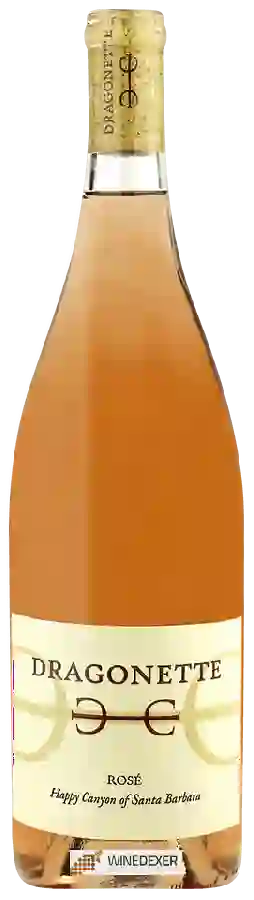
Winery DragonetteRosé
 Pink wine


This wine generally goes well with beef, lamb or mature and hard cheese.

Wine flavors and olphactive analysis





On the nose the Rosé of Winery Dragonette in the region of California often reveals types of flavors of earth, microbio or oak and sometimes also flavors of tree fruit, spices or citrus fruit.
Food and wine pairings with Rosé
Pairings that work perfectly with Rosé



Original food and wine pairings with Rosé

The Rosé of Winery Dragonette matches generally quite well with dishes of beef, lamb or spicy food such as recipes of pasta bolognese, lamb kebab or pork colombo.
Details and technical informations about Winery Dragonette's Rosé.
Discover the grape variety: Mourvèdre
Powerful, deep reds with firm tannins and dense texture, showing aromas of blackberry, leather, garrigue, black pepper, liquorice and animal notes (game, forest floor) with age. Star of Bandol AOC as a single variety and pillar of Châteauneuf-du-Pape, Gigondas and Costières blends. Also in GSM in Languedoc and Australia. A late-ripening variety of Spanish origin (Mataró/Monastrell).
Last vintages of this wine

The best vintages of Rosé from Winery Dragonette are 2015, 2018, 2017, 2016 and 0.
Informations about the Winery Dragonette
The Winery Dragonette is one of of the world's greatest estates. It offers 23 wines for sale in the of Happy Canyon of Santa Barbara to come and discover on site or to buy online.

The wine region of Happy Canyon of Santa Barbara
Warmest sub-zone of Santa Ynez Valley (AVA 2009, 400 acres) east of Santa Barbara: signature Bordeaux varieties — Cabernet Sauvignon, Cabernet Franc, Merlot, Malbec and Petit Verdot in rich ripe reds, emblematic tense Sauvignon Blanc. Sand, gravel and clay soils with rare serpentinite, low yields concentrating aromas. Flavor preceding sugar at ripening: signature depth, ripe fruits, firm tannins and lively acidity.
The wine region of California
Powerful, sunny reds: dense Napa Cabernet Sauvignon (blackcurrant, chocolate, tobacco, ample tannins), spicy, jammy Zinfandel from the Sierra Foothills, silky red-fruited Pinot Noir on the cool coast (Sonoma, Russian River, Central Coast). Opulent, buttery Chardonnay, notes of yellow fruit and vanilla. Varied climate, from the hot interior to the Pacific-cooled coast. 80% of US production, 139 AVAs including Napa (1st AVA, 1981).
The word of the wine: Tartar (deposit)
White, chalky deposits that occur as a result of precipitation inside bottles and are often considered by consumers as a defect. They are in fact tartaric salts formed by tartaric acid, potassium and calcium naturally present in the wine. This deposit does not alter the quality of the wine and can be eliminated by a simple decanting.