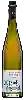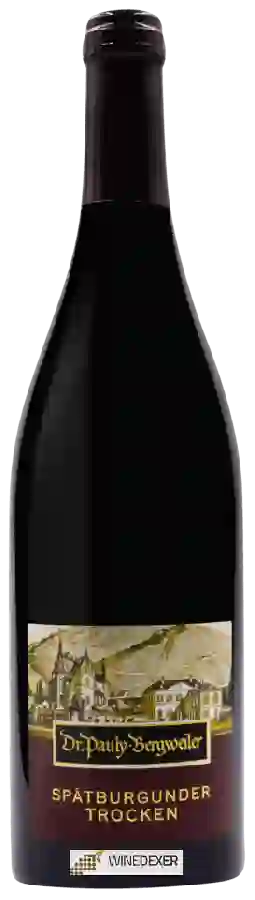
Winery Dr. Pauly-BergweilerSpätburgunder Trocken
 Red wine



In the mouth this red wine is a with a nice freshness.
This wine generally goes well with poultry, beef or veal.
Taste structure of the Spätburgunder Trocken from the Winery Dr. Pauly-Bergweiler
Light | Bold | |
Smooth | Tannic | |
Dry | Sweet | |
Soft | Acidic |
In the mouth the Spätburgunder Trocken of Winery Dr. Pauly-Bergweiler in the region of Mosel is a with a nice freshness.
Food and wine pairings with Spätburgunder Trocken
Pairings that work perfectly with Spätburgunder Trocken



Original food and wine pairings with Spätburgunder Trocken

The Spätburgunder Trocken of Winery Dr. Pauly-Bergweiler matches generally quite well with dishes of beef, veal or game (deer, venison) such as recipes of quick beef bourguignon, chicken in sauce or venison leg in casserole.
Details and technical informations about Winery Dr. Pauly-Bergweiler's Spätburgunder Trocken.
Discover the grape variety: Tinta Barroca
Most certainly Portuguese, more precisely in the Douro region where it is very present. It can be found in Spain, Portugal, South Africa, ... almost unknown in France, registered in the Official Catalogue of A2 list varieties.
Last vintages of this wine
The best vintages of Spätburgunder Trocken from Winery Dr. Pauly-Bergweiler are 0
Informations about the Winery Dr. Pauly-Bergweiler
The Winery Dr. Pauly-Bergweiler is one of of the world's great estates. It offers 71 wines for sale in the of Mosel to come and discover on site or to buy online.

The wine region of Mosel
Mosel is the most famous of Germany's 13 official wine regions, and also the third largest in terms of production. As with many German regions, it is most aasociated with a range of wine styles made from the Riesling grape variety, but Müller-Thurgau is also widely planted. The best Mosel Riesling wines are some of the finest whites in the world. Light and low in Alcohol, they can be intensely fragrant with beguiling Floral">floral and Mineral notes, and a wonderful Balance of sweetness and Acidity.
The word of the wine: Solid
A full-bodied wine, rich in tannins and probably with good ageing potential.