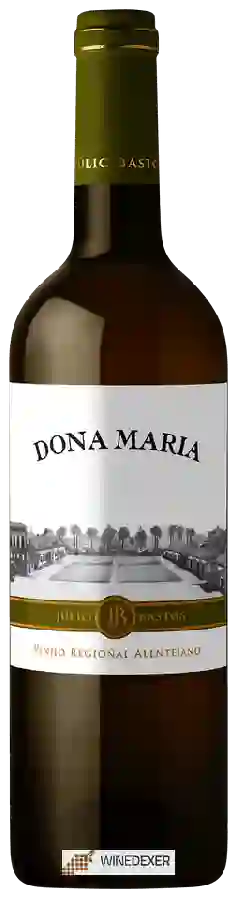
Winery Dona MariaBranco
 White wine



In the mouth this white wine is a powerful.
This wine generally goes well with pork, lean fish or shellfish.
Taste structure of the Branco from the Winery Dona Maria
Light | Bold | |
Dry | Sweet | |
Soft | Acidic |
In the mouth the Branco of Winery Dona Maria in the region of Alentejano is a powerful.
Wine flavors and olphactive analysis





On the nose the Branco of Winery Dona Maria in the region of Alentejano often reveals types of flavors of earth, microbio or vegetal and sometimes also flavors of oak, tree fruit or citrus fruit.
Food and wine pairings with Branco
Pairings that work perfectly with Branco



Original food and wine pairings with Branco

The Branco of Winery Dona Maria matches generally quite well with dishes of pasta, pork or shellfish such as recipes of pasta with artichoke hearts and bacon, stuffed potatoes or wok of shrimps with vegetables.
Details and technical informations about Winery Dona Maria's Branco.
Discover the grape variety: Nerello mascalese
A very old grape variety grown in Italy, more precisely in the north of Sicily on the slopes of Mount Etna and in Sardinia. Its origin would be Greek because it was reported in Greece in the 7th century B.C. It is the result of a natural intraspecific crossing between sangiovese or nielluccio and mantonico bianco. It should not be confused with nerello capuccio and pignatello nero. It should be noted that Nerello mascalese seems to be a grape variety adapted to altitude, as is the case in Sicily where it is planted at a rate of 6,000 and 9,000 vines per hectare. It is practically unknown in other wine-producing countries, which is certainly due to its late ripening.
Last vintages of this wine
The best vintages of Branco from Winery Dona Maria are 2019, 2018, 2017, 2016 and 2012.
Informations about the Winery Dona Maria
The Winery Dona Maria is one of of the world's great estates. It offers 18 wines for sale in the of Alentejano to come and discover on site or to buy online.

The wine region of Alentejano
Tejo">Alentejo is a well-known, highly respected wine region in eastern Portugal. This hot, Dry area covers approximately a third of the country and is best known for its red wine, the best of which are sold under the and Alentejo DOC (Denominacao de Origem Controlada) title. Wine from Alentejo is typically made from Aragonez (Tempranillo), Castelao, Trincadeira or a Rich, ripe, jammy blend of the three. Antao Vaz is the white variety of choice here, producing a good level of Acidity and tropical fruit flavors.
The word of the wine: Aqueous
Said of a diluted wine for which one has the impression that water has been added.