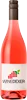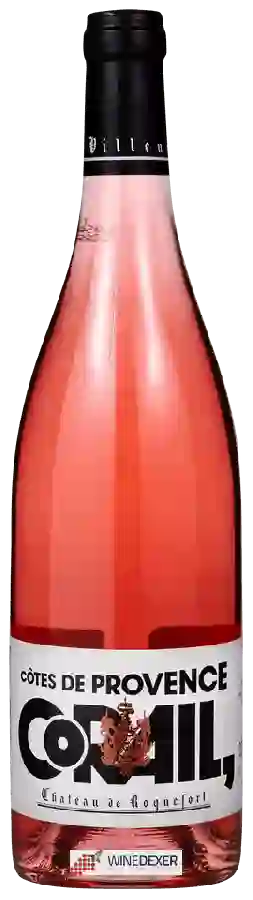
Château de RoquefortCorail Côtes de Provence
 Pink wine


This wine is composed of 100% of the grape variety Grenache.
In the mouth this pink wine is a with a nice freshness.
This wine generally goes well with pork, vegetarian or poultry.

Taste structure of the Corail Côtes de Provence from the Château de Roquefort
Light | Bold | |
Dry | Sweet | |
Soft | Acidic |
In the mouth the Corail Côtes de Provence of Château de Roquefort in the region of Provence is a with a nice freshness.
Wine flavors and olphactive analysis





On the nose the Corail Côtes de Provence of Château de Roquefort in the region of Provence often reveals types of flavors of cherry, grapefruit or citrus and sometimes also flavors of peach, minerality or red fruit.
Food and wine pairings with Corail Côtes de Provence
Pairings that work perfectly with Corail Côtes de Provence



Original food and wine pairings with Corail Côtes de Provence

The Corail Côtes de Provence of Château de Roquefort matches generally quite well with dishes of pork, shellfish or vegetarian such as recipes of new york hot dog, knife feet or vegan leek and tofu quiche.
Details and technical informations about Château de Roquefort's Corail Côtes de Provence.
Discover the grape variety: Clairette
Vibrant and fresh rosés and clairets with a pale robe and tender mouth, featuring aromas of white flowers, citrus, fennel and delicate anise notes. Moderate acidity, light finish. A pink-skinned mutation of clairette blanche, occasionally blended into Provençal and Languedoc rosés. Clairette blanche signs Clairette de Die, Clairette du Languedoc AOC and enters Châteauneuf-du-Pape whites. Native southern French grape.
Last vintages of this wine

The best vintages of Corail Côtes de Provence from Château de Roquefort are 2019, 2018, 2016, 2015 and 2011.
Informations about the Château de Roquefort
The Château de Roquefort is one of of the world's greatest estates. It offers 11 wines for sale in the of Côtes de Provence to come and discover on site or to buy online.

The wine region of Côtes de Provence
World reference for pale, elegant rosé: salmon to onion-skin hue, notes of strawberry, pink grapefruit, white peach and flowers, fresh, dry, mineral palate, taut finish. 90% of output, the Provençal signature. Grenache, Cinsault, Syrah and native Tibouren in the blend. A few fleshy Mediterranean reds (Mourvèdre, Syrah) and saline Vermentino whites.
The wine region of Provence
World capital of dry, refined rosé (~90% of production). Pale rose-petal colour, delicate nose of fresh red fruits (strawberry, raspberry, redcurrant), citrus (pink grapefruit), white flowers and a mineral touch, taut and thirst-quenching palate — the Mediterranean aperitif par excellence. Blends of Grenache, Cinsault, Syrah, Tibouren and Mourvèdre. Fleshy Bandol reds from Mourvèdre (leather, garrigue, age-worthy), straight Cassis whites.
The word of the wine: Maceration
Prolonged contact and exchange between the juice and the grape solids, especially the skin. Not to be confused with the time of fermentation, which follows maceration. The juice becomes loaded with colouring matter and tannins, and acquires aromas. For a rosé, the maceration is short so that the colour does not "rise" too much. For white wines too, a "pellicular maceration" can be practised, which allows the wine to acquire more fat.