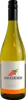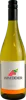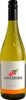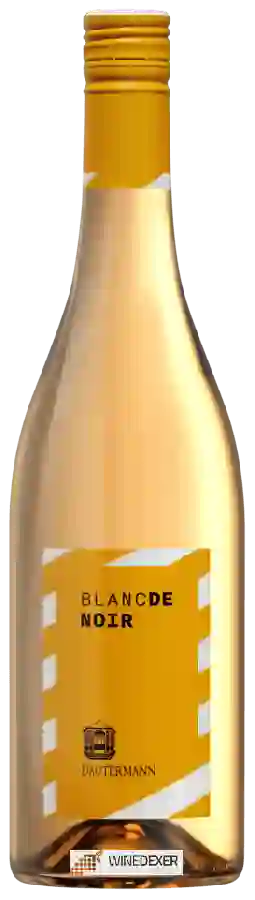
Winery DautermannBlanc de Noirs
 White wine



This wine generally goes well with pork, poultry or veal.
Food and wine pairings with Blanc de Noirs
Pairings that work perfectly with Blanc de Noirs



Original food and wine pairings with Blanc de Noirs


The Blanc de Noirs of Winery Dautermann matches generally quite well with dishes of veal, pork or game (deer, venison) such as recipes of roasted stuffed goose with mushroom sauce, italian pasta or confit sausages.
Details and technical informations about Winery Dautermann's Blanc de Noirs.
Discover the grape variety: Pinot noir
Pinot noir is an important red grape variety in Burgundy and Champagne, and its reputation is well known! Great wines such as the Domaine de la Romanée Conti elaborate their wines from this famous grape variety, and make it a great variety. When properly vinified, pinot noit produces red wines of great finesse, with a wide range of aromas depending on its advancement (fruit, undergrowth, leather). it is also the only red grape variety authorized in Alsace. Pinot Noir is not easily cultivated beyond our borders, although it has enjoyed some success in Oregon, the United States, Australia and New Zealand.
Last vintages of this wine
The best vintages of Blanc de Noirs from Winery Dautermann are 0
Informations about the Winery Dautermann
The Winery Dautermann is one of of the world's great estates. It offers 51 wines for sale in the of Rheinhessen to come and discover on site or to buy online.

The wine region of Rheinhessen
Rheinhessen is Germany's largest region for producing the quality wines of the Qualitätswein bestimmter Anbaugebiete (QbA) and Prädikatswein designations, with roughly 26,500 hectares (65,000 acres) of Vineyard">Vineyards as of 2014. Many of its most significant viticultural areas are favorably influenced by the Rhine river, which runs aLong its North and eastern borders. The Rhine, along with the Nahe river to the west and the Haardt mountains to its South, form a natural border. Rheinhessen covers an area south of Rheingau, north of Pfalz and east of Nahe, and is located within the Rhineland-Palatinate federal state.
The word of the wine: Powdery mildew
Disease of the vine due to a fungus. Less dreadful than mildew, it only attacks the surface of the green parts. Sulphur has long been the best remedy.