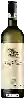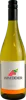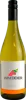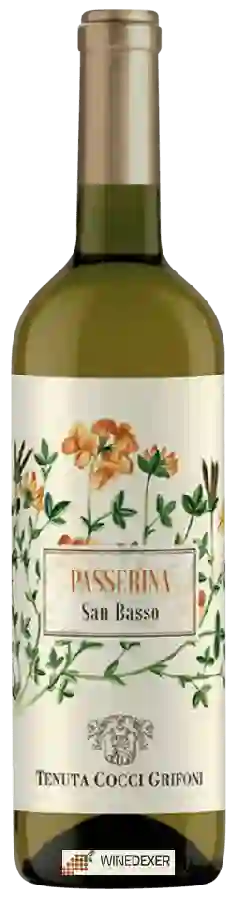
Winery Cocci GrifoniSan Basso Passerina
 White wine


In the mouth this white wine is a with a nice freshness.
This wine generally goes well with vegetarian, appetizers and snacks or lean fish.
Taste structure of the San Basso Passerina from the Winery Cocci Grifoni
Light | Bold | |
Dry | Sweet | |
Soft | Acidic |
In the mouth the San Basso Passerina of Winery Cocci Grifoni in the region of Marche is a with a nice freshness.
Food and wine pairings with San Basso Passerina
Pairings that work perfectly with San Basso Passerina



Original food and wine pairings with San Basso Passerina


The San Basso Passerina of Winery Cocci Grifoni matches generally quite well with dishes of pasta, vegetarian or appetizers and snacks such as recipes of pasta with lemon and comté cheese, summer tuna quiche or verrine of beetroot and lump roe.
Details and technical informations about Winery Cocci Grifoni's San Basso Passerina.
Discover the grape variety: Picolit blanc
A very old grape variety, probably already known to the Romans, and most certainly of Italian origin, from Friuli to be precise. The Hungarian Keknyelu is said to be the same variety, but this remains to be confirmed. It is almost unknown in France and even in the wine world, perhaps because of its low production and its sensitivity to various diseases. It should be noted that it is not related to the black picolit.
Last vintages of this wine

The best vintages of San Basso Passerina from Winery Cocci Grifoni are 2019, 2018, 2017, 0
Informations about the Winery Cocci Grifoni
The Winery Cocci Grifoni is one of of the world's great estates. It offers 45 wines for sale in the of Marche to come and discover on site or to buy online.

The wine region of Marche
Marche (or Le Marche; pronounced Mar-kay) is a region in eastern CentralItaly. It is most associated with white wines made from Trebbiano and Verdicchio grapes. Marche occupies a roughly triangular area. Its longer sides are formed by the Apennine Mountains to the west and the Adriatic Sea to the east.
The word of the wine: Draft liquor (champagne)
After blending, the wine is bottled with a liqueur de tirage (a mixture of sugar and wine) and a yeast (selected yeasts). The yeast attacks the sugar and creates carbon dioxide. The fermentation, which lasts about two months, is prolonged by an ageing period (15 months minimum in total). The bottle is capped (some rare vintages are capped with a staple and a cork).