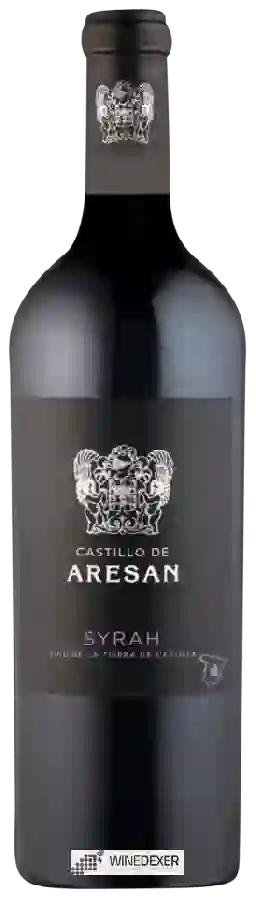
Winery Castillo de AresanSyrah
 Red wine


In the mouth this red wine is a powerful with a lot of tannins present in the mouth.
This wine generally goes well with poultry, beef or game (deer, venison).

Taste structure of the Syrah from the Winery Castillo de Aresan
Light | Bold | |
Smooth | Tannic | |
Dry | Sweet | |
Soft | Acidic |
In the mouth the Syrah of Winery Castillo de Aresan in the region of Castille is a powerful with a lot of tannins present in the mouth.
Food and wine pairings with Syrah
Pairings that work perfectly with Syrah



Original food and wine pairings with Syrah

The Syrah of Winery Castillo de Aresan matches generally quite well with dishes of beef, lamb or game (deer, venison) such as recipes of oxtail confit in red wine, shoulder of lamb with a spoon or duck breast with orange sauce.
Details and technical informations about Winery Castillo de Aresan's Syrah.
Discover the grape variety: Favorita
Lively, aromatic dry whites with a pale golden robe, an elegant palate and preserved acidity, with signature aromas of citrus (lemon, grapefruit), white flowers (acacia), white-fleshed fruits (apple, pear) and saline notes. Refreshing profile, best drunk young. Grown in the Roero and Langhe, a Piedmontese alternative to Ligurian Vermentino. Genetically identical to Vermentino, an autochthonous white variety from Piedmont.
Last vintages of this wine
The best vintages of Syrah from Winery Castillo de Aresan are 2018, 2017, 0
Informations about the Winery Castillo de Aresan
The Winery Castillo de Aresan is one of of the world's great estates. It offers 38 wines for sale in the of Castille to come and discover on site or to buy online.

The wine region of Castille
Cradle of great Castilian reds, high-altitude plateaus (450-1000 m) along the Duero. Tempranillo king (aka Tinta de Toro, Tinto Fino): powerful, concentrated, structured reds with notes of black cherry, plum, leather, tobacco and spice, firm tannins from altitude and cool nights. Stars: Ribera del Duero (Vega Sicilia, Pingus), fleshy Toro, Bierzo (floral, mineral Mencía). Lively, herbaceous Verdejo whites from Rueda.
The word of the wine: Ventilate
Expose the wine to the air before serving, to allow it to open up more, to develop its aromas and to round out its tannins.