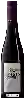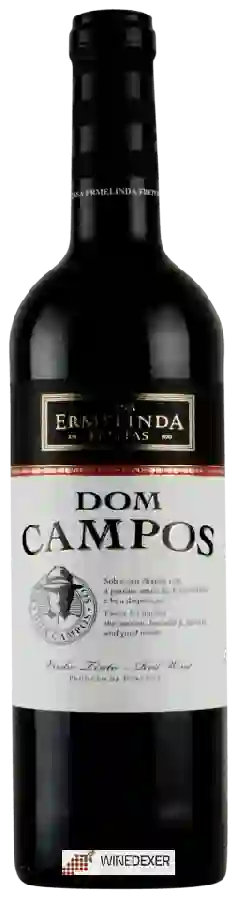
Winery Casa Ermelinda FreitasDom Campos Tinto
 Red wine


In the mouth this red wine is a powerful.
This wine generally goes well with poultry, beef or veal.

Taste structure of the Dom Campos Tinto from the Winery Casa Ermelinda Freitas
Light | Bold | |
Smooth | Tannic | |
Dry | Sweet | |
Soft | Acidic |
In the mouth the Dom Campos Tinto of Winery Casa Ermelinda Freitas in the region of Península de Setúbal is a powerful.
Wine flavors and olphactive analysis


On the nose the Dom Campos Tinto of Winery Casa Ermelinda Freitas in the region of Península de Setúbal often reveals types of flavors of earth, oak or red fruit and sometimes also flavors of black fruit.
Food and wine pairings with Dom Campos Tinto
Pairings that work perfectly with Dom Campos Tinto



Original food and wine pairings with Dom Campos Tinto

The Dom Campos Tinto of Winery Casa Ermelinda Freitas matches generally quite well with dishes of beef, pasta or veal such as recipes of beef tongue in hot pickle sauce, pasta with tuna or veal with cream and mushrooms.
Details and technical informations about Winery Casa Ermelinda Freitas's Dom Campos Tinto.
Discover the grape variety: Cabernet blanc
Aromatic, tense whites with a lean palate and firm acidity. Intense aromas of elderflower, passion fruit, mango, gooseberry, citrus and herbaceous boxwood notes reminiscent of Sauvignon Blanc. Mildew- and powdery-mildew-resistant interspecific variety, driving organic viticulture in Germany, Switzerland, Belgium, the Netherlands and Luxembourg. Swiss hybrid created in 1991 by Valentin Blattner.
Last vintages of this wine

The best vintages of Dom Campos Tinto from Winery Casa Ermelinda Freitas are 2020, 2019, 2018, 2016 and 2015.
Informations about the Winery Casa Ermelinda Freitas
The Winery Casa Ermelinda Freitas is one of wineries to follow in Península de Setúbal.. It offers 106 wines for sale in the of Península de Setúbal to come and discover on site or to buy online.

The wine region of Península de Setúbal
Portuguese peninsula south of Lisbon between the Tagus and Sado estuaries. World-renowned speciality: Moscatel de Setúbal, a golden fortified sweet wine with signature notes of candied orange, dried apricot, honey, fig, currant and sweet spices, long ageing — the rare Roxo version has more floral notes. Also fruity, supple Castelão reds (64%) (blackberry, plum), perfumed Touriga Nacional. Oceanic climate.
The word of the wine: Large plant
See crazy white woman.