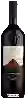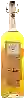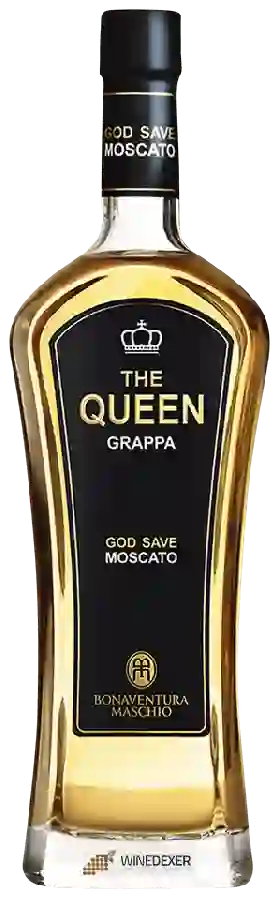
Winery Bonaventura MaschioThe Queen Grappa God Save Moscato
 Sweet wine


This wine generally goes well with sweet desserts
Food and wine pairings with The Queen Grappa God Save Moscato
Pairings that work perfectly with The Queen Grappa God Save Moscato

Original food and wine pairings with The Queen Grappa God Save Moscato
The The Queen Grappa God Save Moscato of Winery Bonaventura Maschio matches generally quite well with dishes of sweet desserts such as recipes of simple pancake batter.
Details and technical informations about Winery Bonaventura Maschio's The Queen Grappa God Save Moscato.
Discover the grape variety: Seyval blanc
A relative of the Saint Pepin, this direct-producing hybrid is the result of an interspecific cross between 5656 Seibel and Ray d'Or (4986 Seibel) obtained in 1921 by the Seyve-Villard company, formerly based in Saint Vallier (Drôme). Seyval blanc is registered in the official catalogue of wine grape varieties, list A. It can be found in the United States, Canada, Brazil, Australia, South Africa, Great Britain, the Netherlands, Germany, Romania, Switzerland, etc. It is practically non-existent in France and is in danger of disappearing.
Last vintages of this wine
The best vintages of The Queen Grappa God Save Moscato from Winery Bonaventura Maschio are 2015, 0
Informations about the Winery Bonaventura Maschio
The Winery Bonaventura Maschio is one of of the world's greatest estates. It offers 14 wines for sale in the of Veneto to come and discover on site or to buy online.

The wine region of Veneto
Veneto is an important and growing wine region in northeastern Italy. Veneto is administratively Part of the Triveneto area, aLong with its smaller neighbors, Trentino-Alto Adige and Friuli-Venezia Giulia. In terms of geography, culture and wine styles, it represents a transition from the Alpine and Germanic-Slavic end of Italy to the warmer, drier, more Roman lands to the South. Veneto is slightly smaller than the other major Italian wine regions - Piedmont, Tuscany, Lombardy, Puglia and Sicily - but it produces more wine than any of them.
The word of the wine: N-M
Negociant-manipulant. Company that buys grapes, sometimes in addition to its own vineyard, elaborates and markets its champagne. Most of the big brands like Moët or Taittinger are N-M.