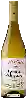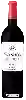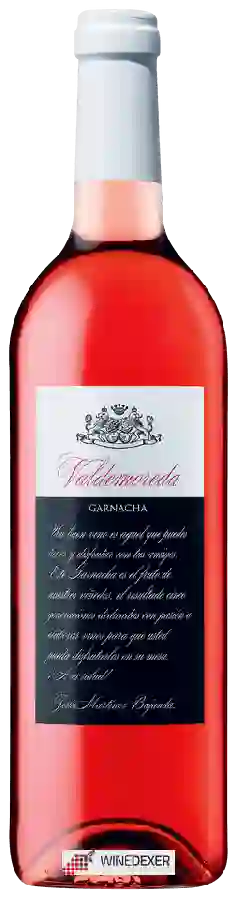
Bodegas ValdemarValdemoreda Rosado
 Pink wine


This wine generally goes well with pork, beef or lamb.

Wine flavors and olphactive analysis


On the nose the Valdemoreda Rosado of Bodegas Valdemar in the region of Rioja often reveals types of flavors of earth, oak or red fruit.
Food and wine pairings with Valdemoreda Rosado
Pairings that work perfectly with Valdemoreda Rosado



Original food and wine pairings with Valdemoreda Rosado

The Valdemoreda Rosado of Bodegas Valdemar matches generally quite well with dishes of beef, lamb or pork such as recipes of wild boar with honey, dad's lamb mouse or chicken ballotine with ham and mushrooms.
Details and technical informations about Bodegas Valdemar's Valdemoreda Rosado.
Discover the grape variety: Calabre blanc
Aromatic dry and semi-dry whites with a pale golden colour, a supple palate with moderate acidity, and characteristic muscat aromas (fresh grape, flowers) with Mediterranean notes. Simple profile. Nearly extinct in commercial cultivation, preserved in varietal collections; witnesses the historical spread of Italian varieties across central and eastern Europe. Historic Italian white variety, once grown in central and southern Italy and eastern Europe.
Last vintages of this wine

The best vintages of Valdemoreda Rosado from Bodegas Valdemar are 2017, 2015, 2016, 2014 and 0.
Informations about the Bodegas Valdemar
The Bodegas Valdemar is one of of the world's great estates. It offers 74 wines for sale in the of Rioja to come and discover on site or to buy online.

The wine region of Rioja
Star of great Spanish reds: signature Tempranillo, elegant and complex, with notes of ripe cherry, plum, leather, vanilla and tobacco from American oak ageing. Classification by age: fruity Joven, balanced Crianza, ample Reserva, deep, silky Gran Reserva (5 years, 2 in barrel). Some fresh Viura whites and generous rosés. Spain's first DOCa (1991), 3 sub-zones (Alta, Alavesa, Oriental), 93.
The word of the wine: Reassembly
During the vinification process, a "cap" is formed at the top of the vats with the solid parts (skin, pulp, pips, etc.), which contain tannins and colouring elements. Pumping over consists of emptying the vat from the bottom and pouring the juice back to the top, in order to mix the cap and the juice and to favour the exchange and the extraction. This old technique allows a better exchange between the solid parts and the liquid.