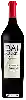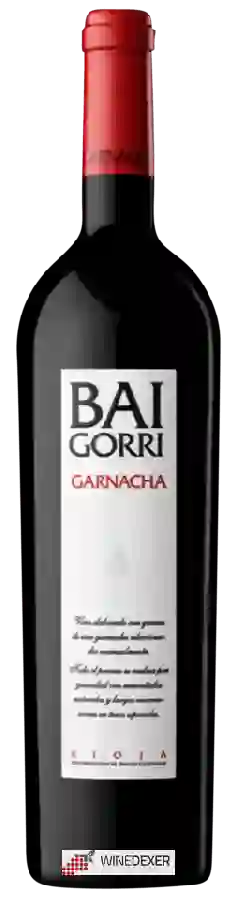
Winery BaigorriRioja Garnacha
 Red wine


In the mouth this red wine is a powerful with a nice freshness.
This wine generally goes well with poultry, beef or game (deer, venison).
The Rioja Garnacha of the Winery Baigorri is in the top 20 of wines of Rioja.

Taste structure of the Rioja Garnacha from the Winery Baigorri
Light | Bold | |
Smooth | Tannic | |
Dry | Sweet | |
Soft | Acidic |
In the mouth the Rioja Garnacha of Winery Baigorri in the region of Rioja is a powerful with a nice freshness.
Wine flavors and olphactive analysis






On the nose the Rioja Garnacha of Winery Baigorri in the region of Rioja often reveals types of flavors of non oak, earth or microbio and sometimes also flavors of oak, spices or red fruit.
Food and wine pairings with Rioja Garnacha
Pairings that work perfectly with Rioja Garnacha



Original food and wine pairings with Rioja Garnacha


The Rioja Garnacha of Winery Baigorri matches generally quite well with dishes of beef, pasta or lamb such as recipes of pork tongue with bacon and onions, salmon cannelloni or tanjia (lamb shoulder confit).
Details and technical informations about Winery Baigorri's Rioja Garnacha.
Discover the grape variety: Muscat bleu
Aromatic and fruity reds with a deep ruby colour, soft tannins and a light palate with preserved acidity, featuring signature muscat aromas (rose, fresh grape), red fruits and flowers. Early ripening and disease resistant. Grown mainly in Switzerland, Germany and the United Kingdom in northern and amateur vineyards, producing original muscat-style red wines. Swiss black hybrid variety obtained in 1932 by complex crossing.
Last vintages of this wine

The best vintages of Rioja Garnacha from Winery Baigorri are 2016, 2015, 2014, 2013 and 2011.
Informations about the Winery Baigorri
The Winery Baigorri is one of of the world's greatest estates. It offers 21 wines for sale in the of Rioja to come and discover on site or to buy online.

The wine region of Rioja
Star of great Spanish reds: signature Tempranillo, elegant and complex, with notes of ripe cherry, plum, leather, vanilla and tobacco from American oak ageing. Classification by age: fruity Joven, balanced Crianza, ample Reserva, deep, silky Gran Reserva (5 years, 2 in barrel). Some fresh Viura whites and generous rosés. Spain's first DOCa (1991), 3 sub-zones (Alta, Alavesa, Oriental), 93.
The word of the wine: PGI
Protected geographical indication. Equivalent to vin de pays in European regulations.