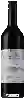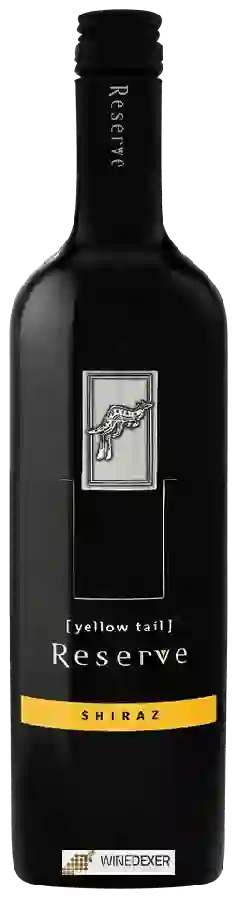
Winery Yellow TailThe Reserve Shiraz
 Red wine



In the mouth this red wine is a powerful with a nice balance between acidity and tannins.
This wine generally goes well with poultry, beef or game (deer, venison).
Taste structure of the The Reserve Shiraz from the Winery Yellow Tail
Light | Bold | |
Smooth | Tannic | |
Dry | Sweet | |
Soft | Acidic |
In the mouth the The Reserve Shiraz of Winery Yellow Tail in the region of Australie du Sud-Est is a powerful with a nice balance between acidity and tannins.
Wine flavors and olphactive analysis



On the nose the The Reserve Shiraz of Winery Yellow Tail in the region of Australie du Sud-Est often reveals types of flavors of cherry, smoke or blackberry and sometimes also flavors of vanilla, licorice or black cherries.
Food and wine pairings with The Reserve Shiraz
Pairings that work perfectly with The Reserve Shiraz



Original food and wine pairings with The Reserve Shiraz

The The Reserve Shiraz of Winery Yellow Tail matches generally quite well with dishes of beef, lamb or game (deer, venison) such as recipes of chinese noodles with beef, leg of lamb in a herb crust with preserved vegetables or roast duck breast stuffed with porcini mushrooms and chanterelles.
Details and technical informations about Winery Yellow Tail's The Reserve Shiraz.
Discover the grape variety: Aubun
Aubun is not to be confused with another grape variety with the same sound, aubin. This one is a black grape plant of which the Vaucluse is the probable cradle. Covering nearly 5,400 hectares of vineyards in the late 1990s, its cultivation was reduced to some 1,400 hectares in the mid-2000s. California and Australia also have discreet plantations. In the Var, Lot-et-Garonne, Gers, Ardèche and other departments, aubun is authorized, if not recommended. Its third-period ripeness promises medium to large bunches of compact, cylindrical grapes that will produce medium-quality wine. Quite alcoholic, the wine produced from Aubun is a lightly colored red. After budburst, the shoots bear young branches covered with a cottony veil. The young leaves are yellowish and downy. The older ones have pubescent, cottony blades with 5 to 7 limbs.
Last vintages of this wine
The best vintages of The Reserve Shiraz from Winery Yellow Tail are 2017, 2018, 2016, 2019 and 2020.
Informations about the Winery Yellow Tail
The Winery Yellow Tail is one of of the world's greatest estates. It offers 60 wines for sale in the of Australie du Sud-Est to come and discover on site or to buy online.

The wine region of Australie du Sud-Est
South East Australia is a geographical indication (GI) covering the entire south-eastern third of Australia. The western boundary of this area extends 2,000 kilometres (1,250 miles) across the Australian continent from the Pacific coast of Queensland to the Southern Ocean coast of South Australia. This vast wine 'super zone' effectively encompasses all the major Australian wine regions outside Western Australia. Rainforest, mountain ranges, scrubland, desert and Dry riverbeds occupy the majority of the land in the South East Australian area.
The word of the wine: Warm
A wine rich in alcohol whose power is expressed by an alcoholic nose and a burning sensation in the mouth.