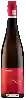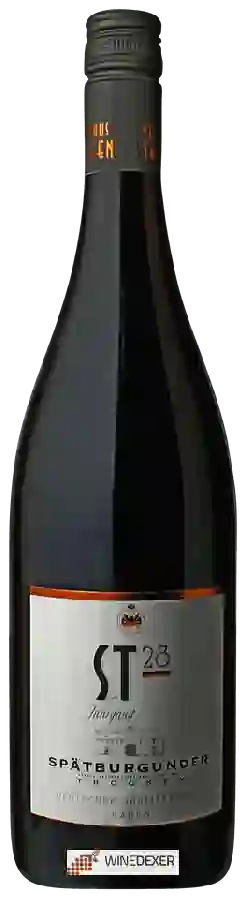
Winery Weinhaus Gebruder SteffenST28 Spätburgunder Trocken
 Red wine



In the mouth this red wine is a with a nice freshness.
This wine generally goes well with poultry, beef or veal.
Taste structure of the ST28 Spätburgunder Trocken from the Winery Weinhaus Gebruder Steffen
Light | Bold | |
Smooth | Tannic | |
Dry | Sweet | |
Soft | Acidic |
In the mouth the ST28 Spätburgunder Trocken of Winery Weinhaus Gebruder Steffen in the region of Baden is a with a nice freshness.
Food and wine pairings with ST28 Spätburgunder Trocken
Pairings that work perfectly with ST28 Spätburgunder Trocken



Original food and wine pairings with ST28 Spätburgunder Trocken

The ST28 Spätburgunder Trocken of Winery Weinhaus Gebruder Steffen matches generally quite well with dishes of beef, veal or game (deer, venison) such as recipes of small stuffed fish from nice, veal tagine with carrots or stuffed duck or goose neck.
Details and technical informations about Winery Weinhaus Gebruder Steffen's ST28 Spätburgunder Trocken.
Discover the grape variety: Mavrud
A very old grape variety whose origin is still uncertain, it is thought to have come from Greece, and for others its origin is Bulgarian from the Thrace plain where it is still widely cultivated. It can be found in Romania, Albania, Greece, Bulgaria, etc. Little known in France, it is nevertheless registered in the Official Catalogue of Wine Grape Varieties, list A1.
Last vintages of this wine
The best vintages of ST28 Spätburgunder Trocken from Winery Weinhaus Gebruder Steffen are 2017, 2016, 0, 2013
Informations about the Winery Weinhaus Gebruder Steffen
The Winery Weinhaus Gebruder Steffen is one of of the world's great estates. It offers 60 wines for sale in the of Baden to come and discover on site or to buy online.

The wine region of Baden
Baden is the southernmost of Germany's 13 official wine regions. It is also the warmest. Its relatively sunny, DryClimate permits the production of good-quality Spätburgunder (Pinot Noir) and ripe, relatively Full-bodied">Full-bodied examples of Grauburgunder (Pinot Gris) and Weissburgunder (Pinot Blanc). These are often made in oaked styles.
The word of the wine: Oenologist
Specialist in wine-making techniques. It is a profession and not a passion: one can be an oenophile without being an oenologist (and the opposite too!). Formerly attached to the Faculty of Pharmacy, oenology studies have become independent and have their own university course. Learning to make wine requires a good chemical background but also, increasingly, a good knowledge of the plant. Some oenologists work in laboratories (analysis). Others, the consulting oenologists, work directly in the properties.