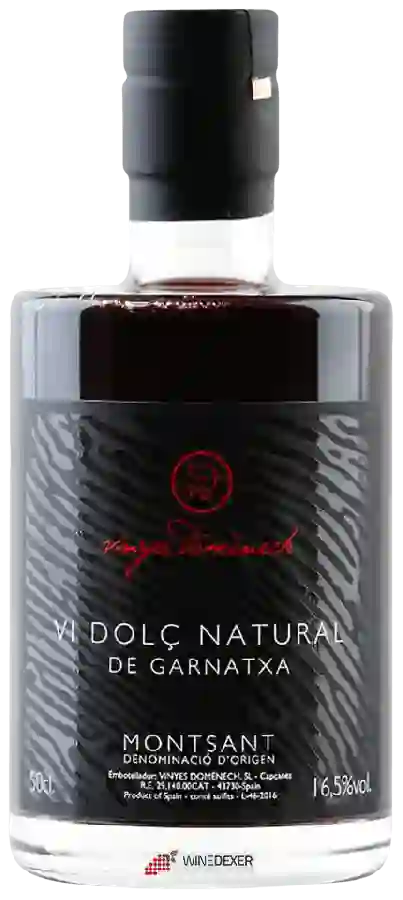
Winery Vinyes DomenechVi Dolç Natural de Garnatxa
 Natural sweet wine
This wine generally goes well with pork, beef or lamb.
Food and wine pairings with Vi Dolç Natural de Garnatxa
Pairings that work perfectly with Vi Dolç Natural de Garnatxa



Original food and wine pairings with Vi Dolç Natural de Garnatxa

The Vi Dolç Natural de Garnatxa of Winery Vinyes Domenech matches generally quite well with dishes of beef, lamb or pork such as recipes of burger roll, leg of lamb in butterfly (barbecue) or oven roasted rabbit that cooks itself!.
Details and technical informations about Winery Vinyes Domenech's Vi Dolç Natural de Garnatxa.
Discover the grape variety: Marzemino
A very old variety grown in northern Italy and recently in Sardinia. It can also be found in Greece, New Zealand, etc. In France it is practically unknown. It is most certainly related to Teroldego and Refosco dal Pedunculo Rosso and is said to be the brother of Lagrein, all three Italian varieties. It is also related to completer.
Informations about the Winery Vinyes Domenech
The Winery Vinyes Domenech is one of of the world's great estates. It offers 18 wines for sale in the of Montsant to come and discover on site or to buy online.

The wine region of Montsant
The wine region of Montsant is located in the region of Tarragona of Catalogne of Spain. Wineries and vineyards like the Domaine Espectacle del Montsant or the Domaine Serra Barcelo produce mainly wines red, white and pink. The most planted grape varieties in the region of Montsant are Cabernet-Sauvignon, Merlot and Tempranillo, they are then used in wines in blends or as a single variety. On the nose of Montsant often reveals types of flavors of earth, cola or melon and sometimes also flavors of nutty, stone or pear.
The wine region of Catalogne
Catalonia (Catalunya in Catalan and Cataluña in Spanish) is an autonomous community in the Northeast of Spain. It extends from the historic county (comarca) of Montsia in the South to the border with France in the north. The Mediterranean Sea forms its eastern border and offers 580 km of coastline. The Catalunya D.
The word of the wine: Defect
Characteristic of a wine that is either aromatically deviant or unbalanced on the palate due to an excess or a lack of one or more flavors.