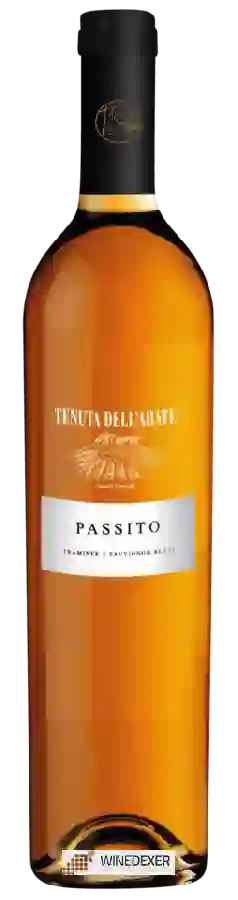
Winery Tenuta dell'AbateTraminer - Sauvignon Blanc Passito
 Sweet wine



This wine generally goes well with vegetarian, appetizers and snacks or shellfish.
Food and wine pairings with Traminer - Sauvignon Blanc Passito
Pairings that work perfectly with Traminer - Sauvignon Blanc Passito



Original food and wine pairings with Traminer - Sauvignon Blanc Passito
The Traminer - Sauvignon Blanc Passito of Winery Tenuta dell'Abate matches generally quite well with dishes of shellfish, vegetarian or appetizers and snacks such as recipes of shrimp and zucchini with curry and coconut milk, zucchini quiche or mozzarella sticks.
Details and technical informations about Winery Tenuta dell'Abate's Traminer - Sauvignon Blanc Passito.
Discover the grape variety: Vidal blanc
An interspecific cross obtained by Jean-Louis Vidal, between Ugni Blanc and 4986 Seibel or Golden Ray, its foliage reminiscent of that of Ugni Blanc. It can be found in the United States and Canada, but is little known in France.
Last vintages of this wine
The best vintages of Traminer - Sauvignon Blanc Passito from Winery Tenuta dell'Abate are 0
Informations about the Winery Tenuta dell'Abate
The Winery Tenuta dell'Abate is one of of the world's great estates. It offers 21 wines for sale in the of Sicily to come and discover on site or to buy online.

The wine region of Sicily
Sicily is the Southernmost region of Italy, and the largest island in the Mediterranean Sea. For over 2500 years, Sicily (Sicilia in Italian) has been an important centre of Mediterranean viticulture, although the reputation and style of its wines have changed considerably over time. The island was once best known for its Sweet muscatels (see Pantelleria), and later for its fortified Marsala. Today, many of its best-known wines are Dry table wines produced under the regional designation IGT Terre Siciliane, or Sicilia DOC (see below).
The word of the wine: Effervescent
Any wine loaded with CO2 (carbon dioxide), which is revealed in the form of bubbles, reinforcing the freshness effect in the mouth. This gas production is the result of what is called the second fermentation in the bottle. It occurs in champagnes and sparkling wines such as crémants.