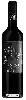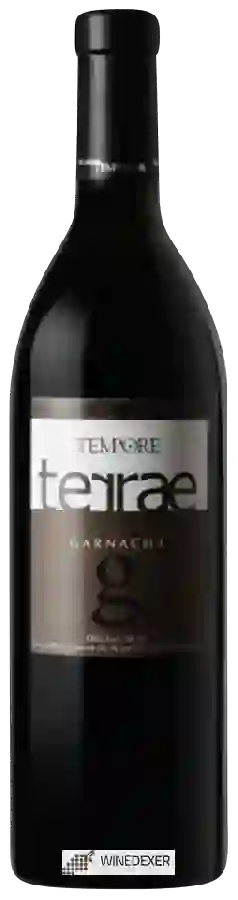
Winery TemporeTerrae Garnacha
 Red wine



In the mouth this red wine is a powerful with a nice balance between acidity and tannins.
This wine generally goes well with poultry, beef or game (deer, venison).
The Terrae Garnacha of the Winery Tempore is in the top 20 of wines of Aragon.
Taste structure of the Terrae Garnacha from the Winery Tempore
Light | Bold | |
Smooth | Tannic | |
Dry | Sweet | |
Soft | Acidic |
In the mouth the Terrae Garnacha of Winery Tempore in the region of Aragon is a powerful with a nice balance between acidity and tannins.
Food and wine pairings with Terrae Garnacha
Pairings that work perfectly with Terrae Garnacha



Original food and wine pairings with Terrae Garnacha


The Terrae Garnacha of Winery Tempore matches generally quite well with dishes of beef, pasta or lamb such as recipes of improved horse steak, quiche with tartiflette or lamb in spicy sauce.
Details and technical informations about Winery Tempore's Terrae Garnacha.
Discover the grape variety: Bobal
This grape variety is widely cultivated in Spain under the name béni carlo. It was introduced into the Languedoc-Roussillon region of Narbonne around 1870.
Last vintages of this wine
The best vintages of Terrae Garnacha from Winery Tempore are 2010, 0, 2012
Informations about the Winery Tempore
The Winery Tempore is one of of the world's great estates. It offers 39 wines for sale in the of Aragon to come and discover on site or to buy online.

The wine region of Aragon
Aragon is one of Spain's 17 autonomous communities. Located in the North of the country, it stretches from the imposing Pyrenees mountains in the South to the vast Central Iberian plateau. To the east of Aragon Lies Catalonia, while La Rioja, Castilla y Leon and Navarra are its neighbours to the west. Aragon encompasses the eastward flowing Ebro River and its vast valley, the river being one of the largest and most important in Spain.
The word of the wine: Sirupy
Close to the sensation of unctuousness, said of a wine that gives the impression of having the consistency of a syrup.