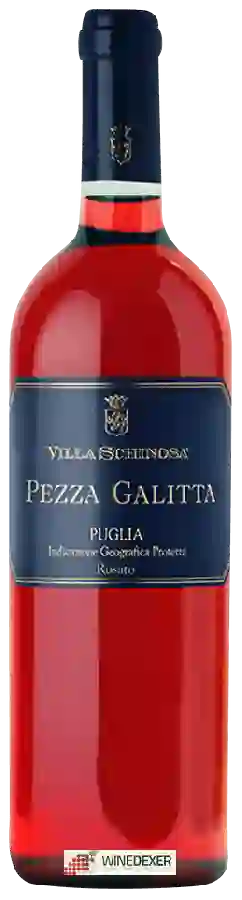
Winery Villa SchinosaPezza Galitta Rosato
 Pink wine



This wine generally goes well with pork, vegetarian or veal.
Food and wine pairings with Pezza Galitta Rosato
Pairings that work perfectly with Pezza Galitta Rosato



Original food and wine pairings with Pezza Galitta Rosato



The Pezza Galitta Rosato of Winery Villa Schinosa matches generally quite well with dishes of lamb, veal or pork such as recipes of dad's lamb mouse, pasta with veal stock sauce or homemade pork curry.
Details and technical informations about Winery Villa Schinosa's Pezza Galitta Rosato.
Discover the grape variety: Aglianico
A very old grape variety grown in Italy, some believe it to be of Greek origin. In France, it is practically unknown. It can be found in Australia, the United States (California), Argentina, etc. It should not be confused with Aglianicone, another grape variety grown in Italy, which is, however, very similar to Aglianico.
Last vintages of this wine
The best vintages of Pezza Galitta Rosato from Winery Villa Schinosa are 0
Informations about the Winery Villa Schinosa
The Winery Villa Schinosa is one of of the world's great estates. It offers 18 wines for sale in the of Puglia to come and discover on site or to buy online.

The wine region of Puglia
Puglia (Apulia to many English speakers) is a Long, slender wine region in the extreme Southeast corner of Italy's "boot". To use the shoe analogy often used to illustrate the shape of Italy, Apulia extends from the tip of the heel to the mid-calf, where the spur of the Gargano Peninsula juts out into the Adriatic Sea. The heel (the Salento peninsula) occupies the southern half of the region and is of great importance for the identity of Puglia. Not only are there cultural and geographical differences from Northern Puglia, but the wines are also different.
The word of the wine: Phylloxera
Aphid that came from America and ravaged European vineyards at the end of the 19th century. It lives on the roots of the vine, from which it pumps the sap. The only vines capable of resisting it had to be imported from the United States, and then grafted onto their root system the wood of traditional French grape varieties. Today, grafted vines are always planted.