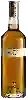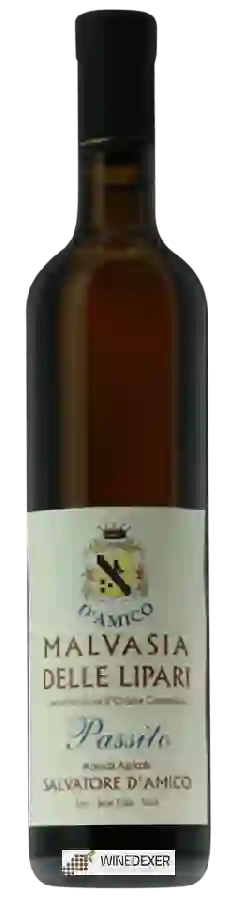
Winery Salvatore d'AmicoMalvasia delle Lipari Passito
 Sweet wine


This wine generally goes well with
Details and technical informations about Winery Salvatore d'Amico's Malvasia delle Lipari Passito.
Discover the grape variety: Tinta da Madeira
Portuguese, more precisely from the island of Madeira where it is still the most cultivated. It can be found in the United States (California), in Spain, etc. In France, it is practically unknown. Its parents are Grenache and Pinot Noir, an intraspecific cross obtained over two hundred years ago. It should be noted that this variety is the father of the egiodola.
Last vintages of this wine
The best vintages of Malvasia delle Lipari Passito from Winery Salvatore d'Amico are 0, 2011
Informations about the Winery Salvatore d'Amico
The Winery Salvatore d'Amico is one of of the world's greatest estates. It offers 9 wines for sale in the of Malvasia delle Lipari to come and discover on site or to buy online.

The wine region of Malvasia delle Lipari
The wine region of Malvasia delle Lipari is located in the region of Sicile of Italy. Wineries and vineyards like the Domaine Caravaglio or the Domaine Hauner produce mainly wines sweet, sparkling and white. On the nose of Malvasia delle Lipari often reveals types of flavors of apples, non oak or peach and sometimes also flavors of dried fruit, citrus fruit or spices. In the mouth of Malvasia delle Lipari is a powerful.
The wine region of Sicily
Sicily is the Southernmost region of Italy, and the largest island in the Mediterranean Sea. For over 2500 years, Sicily (Sicilia in Italian) has been an important centre of Mediterranean viticulture, although the reputation and style of its wines have changed considerably over time. The island was once best known for its Sweet muscatels (see Pantelleria), and later for its fortified Marsala. Today, many of its best-known wines are Dry table wines produced under the regional designation IGT Terre Siciliane, or Sicilia DOC (see below).
The word of the wine: Oenographer
Wine label collector. It is becoming increasingly difficult to obtain the labels of famous vintages, which thus seek to avoid forgeries.