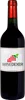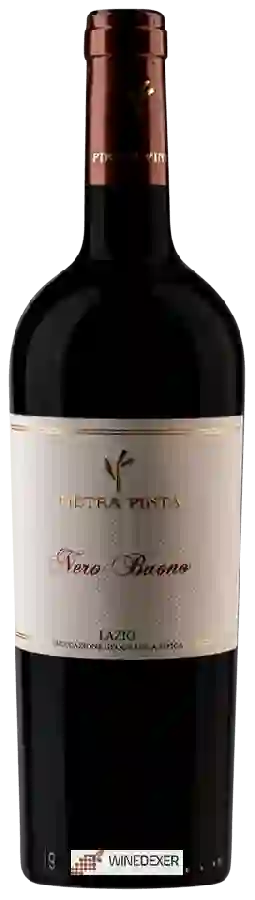
Winery Pietra PintaNero Buono
 Red wine



In the mouth this red wine is a powerful with a nice freshness.
This wine generally goes well with poultry, beef or veal.
Taste structure of the Nero Buono from the Winery Pietra Pinta
Light | Bold | |
Smooth | Tannic | |
Dry | Sweet | |
Soft | Acidic |
In the mouth the Nero Buono of Winery Pietra Pinta in the region of Lazio is a powerful with a nice freshness.


Food and wine pairings with Nero Buono
Pairings that work perfectly with Nero Buono



Original food and wine pairings with Nero Buono

The Nero Buono of Winery Pietra Pinta matches generally quite well with dishes of beef, pasta or veal such as recipes of mexican beef tacos, pasta with chicken, peppers and mushrooms or roast veal orloff with mushrooms.
Details and technical informations about Winery Pietra Pinta's Nero Buono.
Discover the grape variety: Gravesina
We do not know exactly where this grape variety comes from. It can be found in Austria, Romania, northern Italy, Croatia, Serbia, Hungary, Bulgaria, the Czech Republic, Slovakia, Russia, etc. It is practically unknown in France. In Spain, Borba is said to be identical to the Italian Riesling.
Last vintages of this wine
The best vintages of Nero Buono from Winery Pietra Pinta are 2017, 2015, 2012, 2013 and 0.
Informations about the Winery Pietra Pinta
The Winery Pietra Pinta is one of of the world's greatest estates. It offers 14 wines for sale in the of Lazio to come and discover on site or to buy online.

The wine region of Lazio
Lazio is a region in CentralItaly, where the ancient capital of Rome is located. The region's reputation is based primarily on its white wines, the main varieties of which are Trebbiano, Malvasia di Candia and Malvasia Puntinata. Traditionally, these wines were fat, Round, abboccato and intended for immediate consumption. Today, the styles are lighter, drier and crisper thanks to modern winemaking methods.
The word of the wine: Flintstone
Said of an aroma that evokes the smell of flint just from sparking.