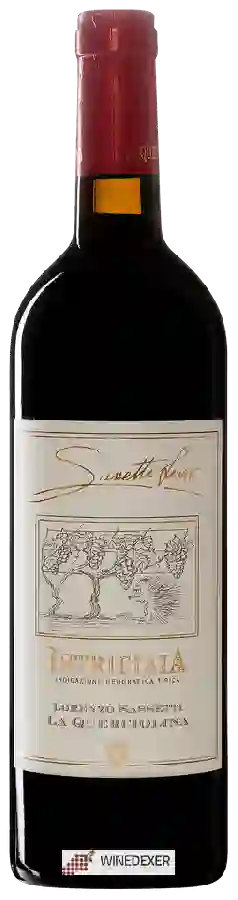
Winery Sassetti LivioIstriciaia Maremma Toscana
 Red wine



This wine is a blend of 2 varietals which are the Ciliegiolo and the Sangiovese.
In the mouth this red wine is a powerful with a nice freshness.
This wine generally goes well with poultry, beef or veal.
The Istriciaia Maremma Toscana of the Winery Sassetti Livio is in the top 70 of wines of Maremma Toscana.
Taste structure of the Istriciaia Maremma Toscana from the Winery Sassetti Livio
Light | Bold | |
Smooth | Tannic | |
Dry | Sweet | |
Soft | Acidic |
In the mouth the Istriciaia Maremma Toscana of Winery Sassetti Livio in the region of Tuscany is a powerful with a nice freshness.
Wine flavors and olphactive analysis





On the nose the Istriciaia Maremma Toscana of Winery Sassetti Livio in the region of Tuscany often reveals types of flavors of non oak, earth or oak and sometimes also flavors of spices, red fruit or black fruit.
Food and wine pairings with Istriciaia Maremma Toscana
Pairings that work perfectly with Istriciaia Maremma Toscana



Original food and wine pairings with Istriciaia Maremma Toscana


The Istriciaia Maremma Toscana of Winery Sassetti Livio matches generally quite well with dishes of beef, lamb or veal such as recipes of quick beef and cheese yakitori, lamb tagine with honey and onions or veal tagine with artichokes and lemons.
Details and technical informations about Winery Sassetti Livio's Istriciaia Maremma Toscana.
Discover the grape variety: Ciliegiolo
It is believed to be of Spanish origin. Today it is very present in Tuscany and in many other Italian regions where it is often blended with sangiovese to produce the famous Chianti. According to recent genetic analysis, it is the father of the said sangiovese, its mother being an almost unknown variety called calabrese di Montenuovo. - Synonymy: ciliegino, ciregiuolo or cireguoli, aleatico di spagna (for all the synonyms of the grape varieties, click here!). - Description: medium to large bunches, cylindrical-conical, winged, compact, strong medium-sized stalks with very little lignification; medium-sized, round berries, skin of medium thickness, very bluish-black with sometimes purplish reflections, juicy pulp. - Production potential: buds early in the year, only a few days after Chasselas. It is particularly fond of not too poor hillside soils. Vigorous, productive and regular, it should however be pruned in relation to the fact that its base eyes are not very fertile. Sensitive to wind, mildew, powdery mildew, acid rot and grey rot. Resistant to drought. Ripening 2nd period late. - Wine type/flavours: gives a full and supple wine with soft tannins, rich in alcohol, of a more or less dark ruby colour with in some cases purplish tints. Aromas of cinnamon, cherry, blueberry, spicy notes, plum, fresh grapes, liquorice, tobacco, vanilla, ... .
Last vintages of this wine
The best vintages of Istriciaia Maremma Toscana from Winery Sassetti Livio are 2008, 2007, 2009, 2011 and 0.
Informations about the Winery Sassetti Livio
The Winery Sassetti Livio is one of of the world's greatest estates. It offers 19 wines for sale in the of Maremma Toscana to come and discover on site or to buy online.

The wine region of Maremma Toscana
The wine region of Maremma Toscana is located in the region of Toscane of Italy. Wineries and vineyards like the Domaine Antinori or the Domaine Rocca di Frassinello produce mainly wines red, white and pink. The most planted grape varieties in the region of Maremma Toscana are Sangiovese, Cabernet-Sauvignon and Merlot, they are then used in wines in blends or as a single variety. On the nose of Maremma Toscana often reveals types of flavors of cherry, game or nutty and sometimes also flavors of hay, white peach or lime.
The wine region of Tuscany
Tuscany is one of the most famous and prolific wine regions in Europe. It is best known for its Dry red wines made from Sangiovese grapes, which dominate production. These include Chianti, Brunello di Montalcino and Vino Nobile di Montepulciano. The region's Vin Santo is also highly prized, as are its passito dessert wines, though these are produced in comparatively tiny quantities.
The word of the wine: Away from the eye
See len de l'el.