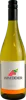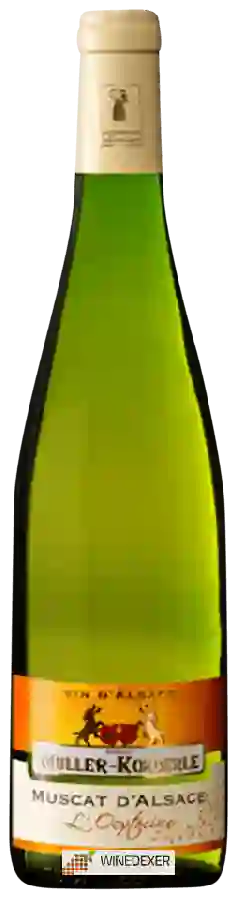
Winery Muller-KoeberleMuscat l'Ocytocine
 White wine
This wine generally goes well with spicy food and sweet desserts.

Food and wine pairings with Muscat l'Ocytocine
Pairings that work perfectly with Muscat l'Ocytocine


Original food and wine pairings with Muscat l'Ocytocine
The Muscat l'Ocytocine of Winery Muller-Koeberle matches generally quite well with dishes of pork, rich fish (salmon, tuna etc) or shellfish such as recipes of ham and cheese cake, salmon steaks with lentils or gari (cassava flour) with shrimps (africa).
Details and technical informations about Winery Muller-Koeberle's Muscat l'Ocytocine.
Discover the grape variety: Muscat Ottonel
Delicate and fine muscat whites with a tender palate and moderate acidity, on intense and refined aromas of orange blossom, rose, fresh grape, citrus, white peach and airy muscat (more subtle than Muscat Blanc à Petits Grains). Made as aromatic dry aperitif whites (Alsace, Baden), off-dry and sumptuous botrytised liquoreux (Burgenland in Austria, Cotnari in Romania, Tokaj). Created in the 19th century by Robert Moreau (Angers), a cross of Chasselas × Muscat de Saumur.
Informations about the Winery Muller-Koeberle
The Winery Muller-Koeberle is one of of the world's great estates. It offers 64 wines for sale in the of Alsace to come and discover on site or to buy online.

The wine region of Alsace
Capital of great French aromatic whites, most often dry and single-varietal. Straight, mineral Riesling (lemon, gunflint), opulent, exuberant Gewurztraminer (lychee, rose, spices), round, smoky Pinot Gris, floral, crisp Muscat, supple Pinot Blanc. Fine, fruity Crémants d'Alsace, exceptional sweet Vendanges Tardives and Sélection de Grains Nobles. 15,500 ha at the foot of the Vosges on varied soils, 51 Grands Crus since 1975.
The word of the wine: Tanin
A natural compound contained in the skin of the grape, the seed or the woody part of the bunch, the stalk. The maceration of red wines allows the extraction of tannins, which give the texture, the solidity and also the mellowness when the tannins are "ripe". The winemaker seeks above all to extract the tannins from the skin, the ripest and most noble. The tannins of the seed or stalk, which are "greener", especially in average years, give the wine hardness and astringency. The wines of Bordeaux (based on Cabernet and Merlot) are full of tannins, those of Burgundy much less so, with Pinot Noir containing little.