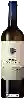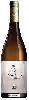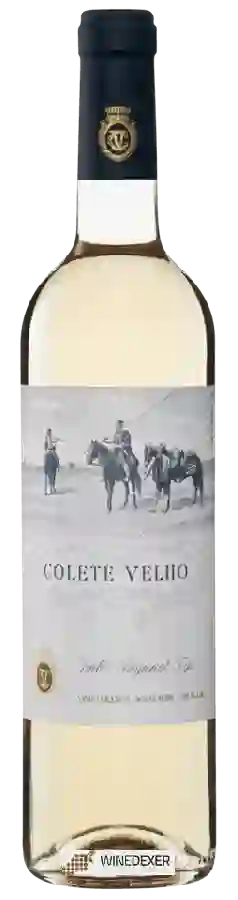
Winery Monte da RavasqueiraColete Velho Branco
 White wine



In the mouth this white wine is a powerful.
This wine generally goes well with pork, lean fish or shellfish.
Taste structure of the Colete Velho Branco from the Winery Monte da Ravasqueira
Light | Bold | |
Dry | Sweet | |
Soft | Acidic |
In the mouth the Colete Velho Branco of Winery Monte da Ravasqueira in the region of Tejo is a powerful.
Food and wine pairings with Colete Velho Branco
Pairings that work perfectly with Colete Velho Branco



Original food and wine pairings with Colete Velho Branco

The Colete Velho Branco of Winery Monte da Ravasqueira matches generally quite well with dishes of pasta, pork or shellfish such as recipes of quiche with tartiflette, savoyard crozet gratin or scupion (small cuttlefish) in hot sauce.
Details and technical informations about Winery Monte da Ravasqueira's Colete Velho Branco.
Discover the grape variety: Malvoisie de l' Istrie
This grape variety is endemic to the Istrian peninsula, which is partly located in Italy, Slovenia and Croatia, where it is the leading white grape variety. In France, it is almost unknown. It is related to malvasia bianca longa, also known as malvasia del Chianti.
Last vintages of this wine
The best vintages of Colete Velho Branco from Winery Monte da Ravasqueira are 2019, 2017, 0, 2018
Informations about the Winery Monte da Ravasqueira
The Winery Monte da Ravasqueira is one of of the world's great estates. It offers 78 wines for sale in the of Tejo to come and discover on site or to buy online.

The wine region of Tejo
Tejo is a wine region in CentralPortugal which covers the same area as the Ribatejo province, just inland from the major city of Lisbon. The wine appellation's name was changed from Ribatejo in 2009. The entire region may use the Tejo VR (Vinho Regional) designation, similar to the French IGP/Vin de Pays, while some areas produce wines labeled with the higher-level Do Tejo DOC (Denominação de Origem Controlada). A Warm, Dry area, it is also Portugal's only landlocked region – although it is influenced considerably by the Tejo river.
The word of the wine: Draft liquor (champagne)
After blending, the wine is bottled with a liqueur de tirage (a mixture of sugar and wine) and a yeast (selected yeasts). The yeast attacks the sugar and creates carbon dioxide. The fermentation, which lasts about two months, is prolonged by an ageing period (15 months minimum in total). The bottle is capped (some rare vintages are capped with a staple and a cork).