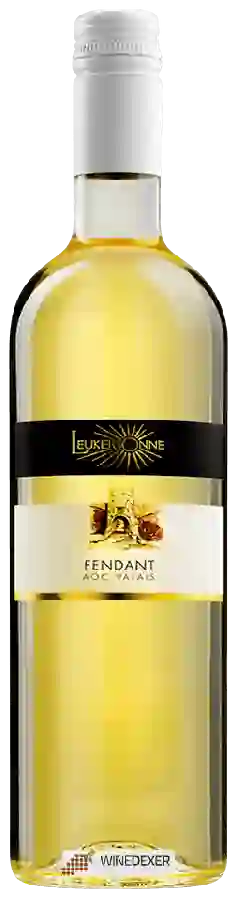
Winery LeukersonneFendant
 White wine



In the mouth this white wine is a with a nice freshness.
This wine generally goes well with poultry, lean fish or mild and soft cheese.

Taste structure of the Fendant from the Winery Leukersonne
Light | Bold | |
Dry | Sweet | |
Soft | Acidic |
In the mouth the Fendant of Winery Leukersonne in the region of Valais is a with a nice freshness.
Wine flavors and olphactive analysis

Food and wine pairings with Fendant
Pairings that work perfectly with Fendant



Original food and wine pairings with Fendant

The Fendant of Winery Leukersonne matches generally quite well with dishes of poultry, lean fish or mild and soft cheese such as recipes of turkey cutlets with feta and cherry tomatoes, papillote of fish with cumin onions or the tartiflette of the savoy grandfather.
Details and technical informations about Winery Leukersonne's Fendant.
Discover the grape variety: Chasselas
Light, lively whites with a tender palate and low acidity, with discreet aromas of fresh hazelnut, white flowers, light honey, apple and strongly terroir-driven mineral notes ("chameleon wine" of Swiss soils). Made as dry, often slightly sparkling whites. Absolute star of Vaud (Dézaley, Calamin, Lavaux Grand Cru) and Valais (Fendant) in Switzerland. Also in Pouilly-sur-Loire AOC and the German Jura. Excellent table grape.
Last vintages of this wine
The best vintages of Fendant from Winery Leukersonne are 2017, 0
Informations about the Winery Leukersonne
The Winery Leukersonne is one of of the world's great estates. It offers 38 wines for sale in the of Valais to come and discover on site or to buy online.

The wine region of Valais
Switzerland's largest vineyard, capital of native grapes. Straight, precise alpine whites: light, floral Chasselas (Fendant), signature Petite Arvine with saline, grapefruit and rhubarb notes, rich, apricoty Amigne, mineral Humagne Blanche. Altitude reds: fine Pinot Noir, crisp Gamay, native Cornalin and Humagne Rouge, spicy and deep. Highly precise alpine age-worthy wines.
The word of the wine: Stirring
In the traditional method, the operation aims to bring the deposits against the cork by the movement of the bottles placed on desks. The stirring can be manual or mechanical (using gyropalettes).