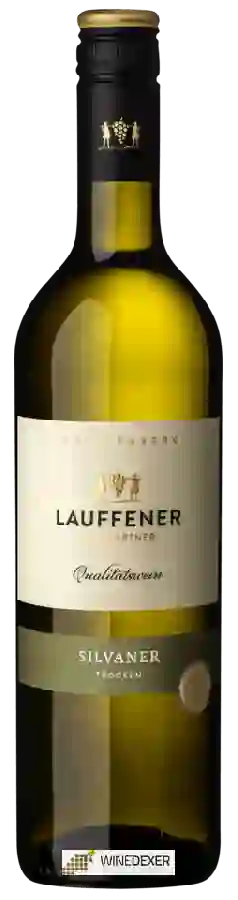
Winery LauffenerSilvaner Trocken
 White wine


In the mouth this white wine is a .
This wine generally goes well with pork, vegetarian or poultry.
Taste structure of the Silvaner Trocken from the Winery Lauffener
Light | Bold | |
Dry | Sweet | |
Soft | Acidic |
In the mouth the Silvaner Trocken of Winery Lauffener in the region of Württemberg is a .
Food and wine pairings with Silvaner Trocken
Pairings that work perfectly with Silvaner Trocken



Original food and wine pairings with Silvaner Trocken


The Silvaner Trocken of Winery Lauffener matches generally quite well with dishes of veal, pork or vegetarian such as recipes of puchero, quiche with mixed vegetables or quiche without eggs.
Details and technical informations about Winery Lauffener's Silvaner Trocken.
Discover the grape variety: Trepat
A very old grape variety found mainly in Catalonia (Spain), in the regions of Conca de Barbera and Costers del Segre, and also in the Balearic Islands, Murcia, Valencia, etc. It is said to be related to the white heben and has no link with the white trepat of Priorat. Before the phylloxera crisis, it could be found in Languedoc and Roussillon, which is no longer the case today, but it could be interesting for producing excellent and original rosé wines.
Last vintages of this wine
The best vintages of Silvaner Trocken from Winery Lauffener are 0
Informations about the Winery Lauffener
The Winery Lauffener is one of of the world's great estates. It offers 92 wines for sale in the of Württemberg to come and discover on site or to buy online.

The wine region of Württemberg
Württemberg is known as Germany's premier red wine region. With almost 11,500 hectares (28,500 acres) of vineyards, it is the fourth-largest wine region in the country. Found adjacent to Baden and South of Franken, Wüttemberg is a particularly hilly and rural wine-region. Almost 70-percent of Württemberg wines are red, predominantly made from Trollinger, SchwarzRiesling and Lemberger.
The word of the wine: Aging on lees
Maturing on the lees enhances the stability, aromatic complexity and texture of white wines, which gain in body and volume. This phenomenon is induced by autolysis, the process of self-degradation of the lees.