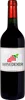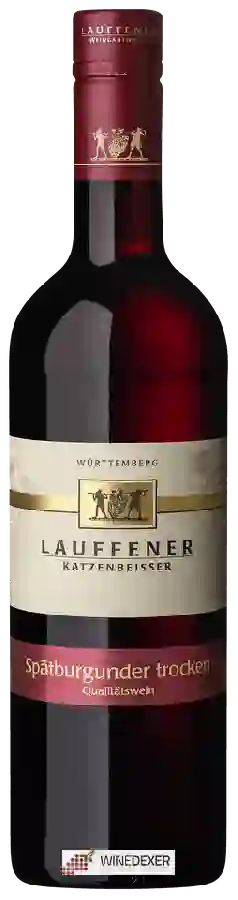
Winery LauffenerKatzenbeisser Spätburgunder Trocken
 Red wine


In the mouth this red wine is a with a nice freshness.
This wine generally goes well with poultry, beef or veal.
Taste structure of the Katzenbeisser Spätburgunder Trocken from the Winery Lauffener
Light | Bold | |
Smooth | Tannic | |
Dry | Sweet | |
Soft | Acidic |
In the mouth the Katzenbeisser Spätburgunder Trocken of Winery Lauffener in the region of Württemberg is a with a nice freshness.
Food and wine pairings with Katzenbeisser Spätburgunder Trocken
Pairings that work perfectly with Katzenbeisser Spätburgunder Trocken



Original food and wine pairings with Katzenbeisser Spätburgunder Trocken

The Katzenbeisser Spätburgunder Trocken of Winery Lauffener matches generally quite well with dishes of beef, veal or game (deer, venison) such as recipes of fondue vigneronne au vin rouge, sarthe pot or rabbit in sauce.
Details and technical informations about Winery Lauffener's Katzenbeisser Spätburgunder Trocken.
Discover the grape variety: Airen
This is a very old variety that is still very present in Spain, and can also be found in Portugal, but is practically unknown in France. It is registered in the Official Catalogue of wine grape varieties list A.
Last vintages of this wine

The best vintages of Katzenbeisser Spätburgunder Trocken from Winery Lauffener are 2017, 2015, 0, 2016 and 2018.
Informations about the Winery Lauffener
The Winery Lauffener is one of of the world's great estates. It offers 92 wines for sale in the of Württemberg to come and discover on site or to buy online.

The wine region of Württemberg
Württemberg is known as Germany's premier red wine region. With almost 11,500 hectares (28,500 acres) of vineyards, it is the fourth-largest wine region in the country. Found adjacent to Baden and South of Franken, Wüttemberg is a particularly hilly and rural wine-region. Almost 70-percent of Württemberg wines are red, predominantly made from Trollinger, SchwarzRiesling and Lemberger.
The word of the wine: INAO glass
Glass adapted to wine tasting, created in the 1970s by the Institut national des appellations d'origine. At the time, it had the advantage of offering a standardised tool to all tasters. It is characterized by a wide base that allows for good ventilation and a narrow mouth (opening of the glass) to concentrate the aromas. Many high-performance glasses have been created based on this model.