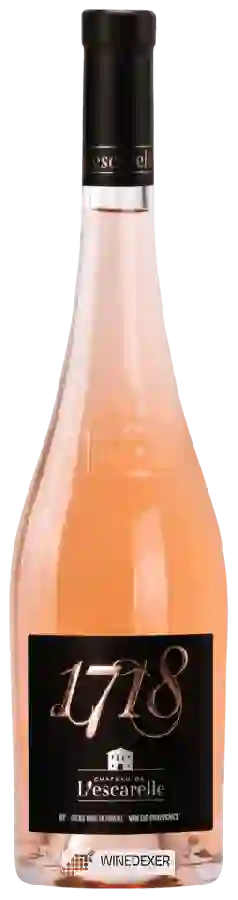
Château de l'Escarelle1718 Rosé
 Pink wine



In the mouth this pink wine is a with a nice freshness.
This wine generally goes well with pork, vegetarian or poultry.

Taste structure of the 1718 Rosé from the Château de l'Escarelle
Light | Bold | |
Dry | Sweet | |
Soft | Acidic |
In the mouth the 1718 Rosé of Château de l'Escarelle in the region of Provence is a with a nice freshness.
Food and wine pairings with 1718 Rosé
Pairings that work perfectly with 1718 Rosé



Original food and wine pairings with 1718 Rosé

The 1718 Rosé of Château de l'Escarelle matches generally quite well with dishes of pork, shellfish or vegetarian such as recipes of pork roll with tomato sauce, cuttlefish armorican style (morgate) or ham and comté quiche.
Details and technical informations about Château de l'Escarelle's 1718 Rosé.
Discover the grape variety: Oeillade noire
Light and fruity reds with a pale, lightly coloured ruby robe, smooth tannins, an airy palate with moderate acidity, and aromas of red fruits (strawberry, raspberry), soft spices and floral notes. Accessible southern profile. Preserved for its heritage value, surviving in a few southern French plots; studied for its ampelographic interest. Native French black variety from Provence and Languedoc, identical to Cinsault according to some analyses.
Informations about the Château de l'Escarelle
The Château de l'Escarelle is one of of the world's great estates. It offers 44 wines for sale in the of Coteaux Varois en Provence to come and discover on site or to buy online.

The wine region of Coteaux Varois en Provence
Provençal AOC of the Var hinterland (28 villages, ~2,229 ha) tempered by the Sainte-Baume massif. Signature rosés dominate (91%): pale robe with signature notes of strawberry, grapefruit, white peach, flowers (rose, garrigue) and a citrus touch, fresh and thirst-quenching palate — more structured and mineral than the coast thanks to altitude. Cinsault, Grenache, Syrah, Mourvèdre at the base, local Tibouren. Supple cherry-garrigue reds, Rolle and Clairette whites.
The wine region of Provence
World capital of dry, refined rosé (~90% of production). Pale rose-petal colour, delicate nose of fresh red fruits (strawberry, raspberry, redcurrant), citrus (pink grapefruit), white flowers and a mineral touch, taut and thirst-quenching palate — the Mediterranean aperitif par excellence. Blends of Grenache, Cinsault, Syrah, Tibouren and Mourvèdre. Fleshy Bandol reds from Mourvèdre (leather, garrigue, age-worthy), straight Cassis whites.
The word of the wine: Cup (size in)
Specific to the Mediterranean vineyard, this short pruning which opens the stock in the shape of a corolla offers a good resistance to violent winds but does not allow any mechanization of the vine work.