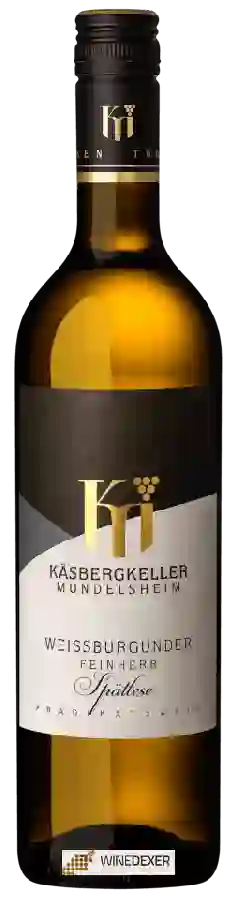
Winery Käsbergkeller MundelsheimWeissburgunder Feinherb Spätlese
 White wine
In the mouth this white wine is a with a nice freshness.
This wine generally goes well with rich fish (salmon, tuna etc), shellfish or mild and soft cheese.
Taste structure of the Weissburgunder Feinherb Spätlese from the Winery Käsbergkeller Mundelsheim
Light | Bold | |
Dry | Sweet | |
Soft | Acidic |
In the mouth the Weissburgunder Feinherb Spätlese of Winery Käsbergkeller Mundelsheim in the region of Württemberg is a with a nice freshness.
Food and wine pairings with Weissburgunder Feinherb Spätlese
Pairings that work perfectly with Weissburgunder Feinherb Spätlese



Original food and wine pairings with Weissburgunder Feinherb Spätlese

The Weissburgunder Feinherb Spätlese of Winery Käsbergkeller Mundelsheim matches generally quite well with dishes of rich fish (salmon, tuna etc), shellfish or mild and soft cheese such as recipes of salmon with honey and soy, yellow risotto with mussels or filet mignon in a mustard crust.
Details and technical informations about Winery Käsbergkeller Mundelsheim's Weissburgunder Feinherb Spätlese.
Discover the grape variety: Cabernet-Jura
An interspecific cross between Cabernet Sauvignon and a still unknown relative, obtained in 1991 by Valentin Blatter of Soyhières (Switzerland). Cabernet-Jura can be found in Switzerland, Belgium, the Netherlands, Germany, etc., but is still little known in France.
Informations about the Winery Käsbergkeller Mundelsheim
The Winery Käsbergkeller Mundelsheim is one of of the world's great estates. It offers 59 wines for sale in the of Württemberg to come and discover on site or to buy online.

The wine region of Württemberg
Württemberg is known as Germany's premier red wine region. With almost 11,500 hectares (28,500 acres) of vineyards, it is the fourth-largest wine region in the country. Found adjacent to Baden and South of Franken, Wüttemberg is a particularly hilly and rural wine-region. Almost 70-percent of Württemberg wines are red, predominantly made from Trollinger, SchwarzRiesling and Lemberger.
The word of the wine: Sulphur
An antiseptic and antioxidant substance known since antiquity, probably already used by the Romans. But it was only in modern times that its use was rediscovered. It will allow a better conservation of the wine and thus favour its export. Sulphur also gave the 18th century winegrower the possibility of extending the maceration period without fearing that the wine would turn sour and thus go from dark rosé wines to the red wines of today. Excessive sulphur, on the other hand, kills happiness, paralysing the aromas and causing headaches.