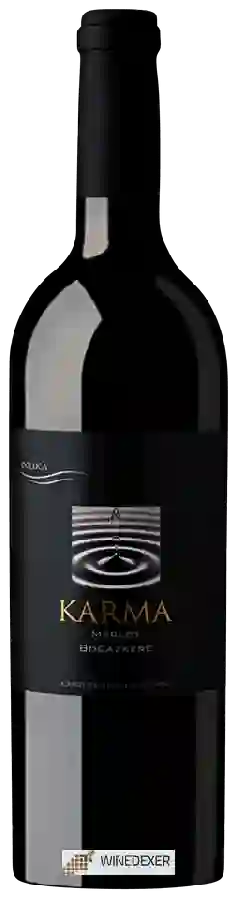
Winery KarmaMerlot - Boğazkere
 Red wine



This wine is a blend of 2 varietals which are the Bogazkere and the Merlot.
This wine generally goes well with beef and game (deer, venison).

Wine flavors and olphactive analysis




On the nose the Merlot - Boğazkere of Winery Karma in the region of Thrace often reveals types of flavors of non oak, earth or oak and sometimes also flavors of spices, red fruit or black fruit.
Food and wine pairings with Merlot - Boğazkere
Pairings that work perfectly with Merlot - Boğazkere


Original food and wine pairings with Merlot - Boğazkere
The Merlot - Boğazkere of Winery Karma matches generally quite well with dishes of beef or game (deer, venison) such as recipes of stuffed peppers or rabbit on the barbecue.
Discover the grape variety: Bogazkere
Powerful, tannic reds with an almost black ink-dark robe, firm, astringent tannins and a dense palate, showing intense aromas of blackberry, blackcurrant, black plum, leather, spices, tobacco and balsamic notes. Fine ageing potential. Star of the great Turkish reds on the arid terroirs of south-east Anatolia (Diyarbakır region, Tigris valley), often blended with öküzgözü to soften its structure. Autochthonous Anatolian variety, its name means "throat-burner" in Turkish.
Last vintages of this wine
The best vintages of Merlot - Boğazkere from Winery Karma are 2008, 2010, 2014, 2015 and 2013.
Informations about the Winery Karma
The Winery Karma is one of of the world's greatest estates. It offers 4 wines for sale in the of Thrace to come and discover on site or to buy online.

The wine region of Thrace
Eastern region shared between Turkey, Greece and Bulgaria, a fascinating native palette. On the Turkish side, Öküzgözü ("ox eye") is the signature red: deep ruby with signature notes of ripe cherry, raspberry, plum, spice and a floral touch, supple tannins and lively acidity. More tannic, structured Boğazkere, local Papazkarası. Fresh Narince whites (citrus, flowers, almond), lively Emir.
The word of the wine: Aroma
A pleasant smell that can be primary (or varietal, i.e. characteristic of the grape), secondary (resulting from fermentation) or tertiary (resulting from the aging of the wine in the bottle).