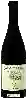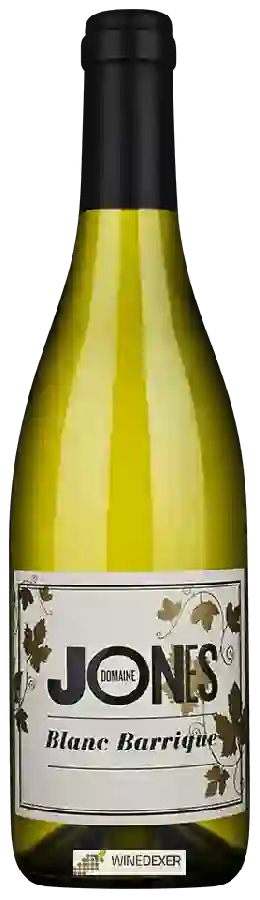
Winery JonesBlanc Barrique
 White wine


In the mouth this white wine is a powerful.
This wine generally goes well with vegetarian, poultry or lean fish.
Taste structure of the Blanc Barrique from the Winery Jones
Light | Bold | |
Dry | Sweet | |
Soft | Acidic |
In the mouth the Blanc Barrique of Winery Jones in the region of Languedoc-Roussillon is a powerful.
Wine flavors and olphactive analysis




On the nose the Blanc Barrique of Winery Jones in the region of Languedoc-Roussillon often reveals types of flavors of oaky, apples or nutty and sometimes also flavors of non oak, oak or tree fruit.
Food and wine pairings with Blanc Barrique
Pairings that work perfectly with Blanc Barrique



Original food and wine pairings with Blanc Barrique


The Blanc Barrique of Winery Jones matches generally quite well with dishes of pasta, vegetarian or poultry such as recipes of tuscan linguine, vegan leek and tofu quiche or potato and bacon omelette.
Details and technical informations about Winery Jones's Blanc Barrique.
Discover the grape variety: Muscaris
An interspecific cross between Solaris and Muscat à petits grains blancs, obtained in Freiburg (Germany) in 1987 by Norbert Becker. It has the particularity of having only one gene for resistance to mildew and powdery mildew. Muscaris can be found in Germany, the Netherlands, Italy and France.
Last vintages of this wine
The best vintages of Blanc Barrique from Winery Jones are 2011
Informations about the Winery Jones
The Winery Jones is one of of the world's great estates. It offers 49 wines for sale in the of Languedoc-Roussillon to come and discover on site or to buy online.

The wine region of Languedoc-Roussillon
Languedoc (formerly Coteaux du Languedoc) is a key appellation used in the Languedoc-Roussillon wine region of southern France. It covers Dry table wines of all three colors (red, white and rosé) from the entire region, but leaves Sweet and Sparkling wines to other more specialized appellations. About 75% of all Languedoc wines are red, with the remaining 25% split roughly down the middle between whites and rosés. The appellation covers most of the Languedoc region and almost a third of all the vineyards in France.
The word of the wine: Passerillage
Concentration of the grape by drying out, under the influence of wind or sun, as opposed to botrytisation, which is the concentration obtained by the development of the "noble rot" for which Botrytis cinerea is responsible. The word is mainly used for sweet wines.