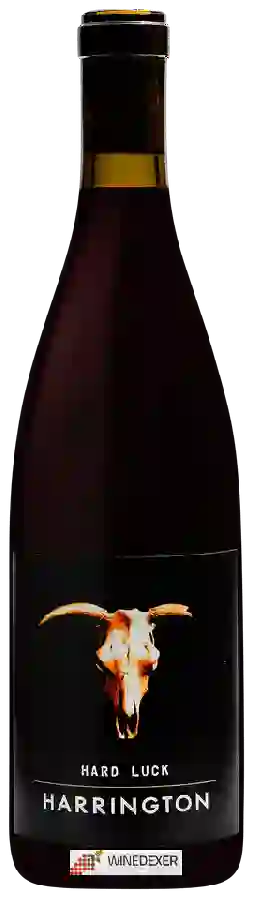
Winery HarringtonHard Luck
 Red wine


In the mouth this red wine is a powerful with a nice balance between acidity and tannins.
This wine generally goes well with poultry, beef or veal.

Taste structure of the Hard Luck from the Winery Harrington
Light | Bold | |
Smooth | Tannic | |
Dry | Sweet | |
Soft | Acidic |
In the mouth the Hard Luck of Winery Harrington in the region of California is a powerful with a nice balance between acidity and tannins.
Food and wine pairings with Hard Luck
Pairings that work perfectly with Hard Luck



Original food and wine pairings with Hard Luck

The Hard Luck of Winery Harrington matches generally quite well with dishes of beef, lamb or veal such as recipes of romazava (madagascar), lamb mouse confit in wine or sauté of veal with carrots.
Details and technical informations about Winery Harrington's Hard Luck.
Discover the grape variety: Viktoria
Simple, fresh dry whites with a pale golden robe, a supple palate with moderate acidity, and undemonstrative aromas of citrus and white flowers. Rustic, discreet profile. Preserved in a few ampelographic collections for its heritage value, it is an ancient variety whose commercial distribution has virtually disappeared, studied for its genetic and historical interest. Rare, poorly documented white variety grown in confidential quantities.
Last vintages of this wine
The best vintages of Hard Luck from Winery Harrington are 2014, 0
Informations about the Winery Harrington
The Winery Harrington is one of of the world's greatest estates. It offers 63 wines for sale in the of California to come and discover on site or to buy online.

The wine region of California
Powerful, sunny reds: dense Napa Cabernet Sauvignon (blackcurrant, chocolate, tobacco, ample tannins), spicy, jammy Zinfandel from the Sierra Foothills, silky red-fruited Pinot Noir on the cool coast (Sonoma, Russian River, Central Coast). Opulent, buttery Chardonnay, notes of yellow fruit and vanilla. Varied climate, from the hot interior to the Pacific-cooled coast. 80% of US production, 139 AVAs including Napa (1st AVA, 1981).
The word of the wine: Vatting
After five to eight days of alcoholic fermentation, it is possible to prolong the maceration in order to extract the maximum amount of matter from the marc. The wines obtained in this way are rich and full-bodied, and in principle are intended for laying down.