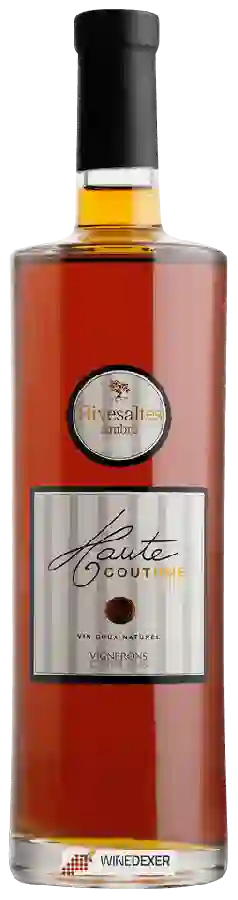
Winery Vignerons CatalansHaute Coutume Rivesaltes Ambré
 Sweet wine


This wine generally goes well with beef and mature and hard cheese.
Wine flavors and olphactive analysis




On the nose the Haute Coutume Rivesaltes Ambré of Winery Vignerons Catalans in the region of Languedoc-Roussillon often reveals types of flavors of apricot, cheese or non oak and sometimes also flavors of microbio, oak or tree fruit.
Food and wine pairings with Haute Coutume Rivesaltes Ambré
Pairings that work perfectly with Haute Coutume Rivesaltes Ambré


Original food and wine pairings with Haute Coutume Rivesaltes Ambré
The Haute Coutume Rivesaltes Ambré of Winery Vignerons Catalans matches generally quite well with dishes of beef or mature and hard cheese such as recipes of alsatian bäckeoffe or pasta with lemon and comté cheese.
Details and technical informations about Winery Vignerons Catalans's Haute Coutume Rivesaltes Ambré.
Discover the grape variety: Couderc 13
A direct producer hybrid obtained by Georges Couderc by crossing Vitis Lincecumii (Buckley) with 162-5 Couderc, the latter having 3/4 blood of Vinifera-Rupestris. Today, like most hybrids, it has practically disappeared. It can still be found in a mixture in very old vineyards, the photographs below were taken in the Ardèche, on the border with the Gard, north of Saint Ambroix.
Last vintages of this wine
The best vintages of Haute Coutume Rivesaltes Ambré from Winery Vignerons Catalans are 1996, 1988, 1976
Informations about the Winery Vignerons Catalans
The Winery Vignerons Catalans is one of of the world's greatest estates. It offers 199 wines for sale in the of Rivesaltes to come and discover on site or to buy online.

The wine region of Rivesaltes
Rivesaltes is an appellation for the historic Sweet wines of eastern Roussillon, in the DeepSouth of France. The natural sweet wines produced in this region have been revered since at least the 14th century. The technique used to make them is one of many techniques used for sweet wines. Unlike botrytized wines or ice wines, natural sweet wines are made by Mutage, a process that involves stopping the Fermentation of the must while a high level of natural sweetness remains.
The wine region of Languedoc-Roussillon
Languedoc (formerly Coteaux du Languedoc) is a key appellation used in the Languedoc-Roussillon wine region of southern France. It covers Dry table wines of all three colors (red, white and rosé) from the entire region, but leaves Sweet and Sparkling wines to other more specialized appellations. About 75% of all Languedoc wines are red, with the remaining 25% split roughly down the middle between whites and rosés. The appellation covers most of the Languedoc region and almost a third of all the vineyards in France.
The word of the wine: Acescence
An alteration in wine also known as pitting (hence the expression piqué wine), due to the presence of acetic acid and ethyl acetate, and characterized by a vinegar-like odor.