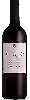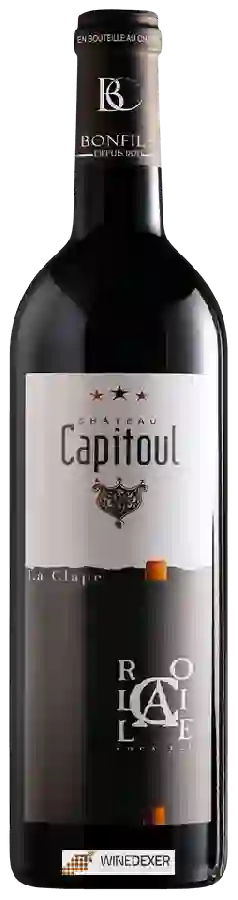
Château CapitoulRocaille La Clape Rouge
 Red wine



This wine is a blend of 2 varietals which are the Syrah and the Grenache noir.
In the mouth this red wine is a powerful with a nice balance between acidity and tannins.
This wine generally goes well with beef, veal or pasta.

Taste structure of the Rocaille La Clape Rouge from the Château Capitoul
Light | Bold | |
Smooth | Tannic | |
Dry | Sweet | |
Soft | Acidic |
In the mouth the Rocaille La Clape Rouge of Château Capitoul in the region of Languedoc-Roussillon is a powerful with a nice balance between acidity and tannins.
Wine flavors and olphactive analysis




On the nose the Rocaille La Clape Rouge of Château Capitoul in the region of Languedoc-Roussillon often reveals types of flavors of cherry, oaky or blackberry and sometimes also flavors of red fruit, leather or pepper.
Food and wine pairings with Rocaille La Clape Rouge
Pairings that work perfectly with Rocaille La Clape Rouge



Original food and wine pairings with Rocaille La Clape Rouge
The Rocaille La Clape Rouge of Château Capitoul matches generally quite well with dishes of beef, veal or pasta such as recipes of sautéed pork with pineapple, pljeskavica (balkan hamburger) or mascarpone/gorgonzola macaroni gratin.
Details and technical informations about Château Capitoul's Rocaille La Clape Rouge.
Discover the grape variety: Syrah
Structured, elegant reds with deep colour, firm tannins, with intense aromas of blackberry, blackcurrant, black pepper, violet, smoked meat, black olive and balsamic notes. Fine ageing potential. Star of the great northern Rhône reds (Côte-Rôtie, Hermitage, Cornas, Saint-Joseph) and pillar of GSM blends in the south (Châteauneuf-du-Pape). Widely exported to Australia as Shiraz (Barossa, McLaren Vale). Cross of dureza × mondeuse blanche.
Last vintages of this wine
The best vintages of Rocaille La Clape Rouge from Château Capitoul are 2021, 2020, 2012, 2019 and 2014.
Informations about the Château Capitoul
The Château Capitoul is one of of the world's greatest estates. It offers 41 wines for sale in the of La Clape to come and discover on site or to buy online.

The wine region of La Clape
AOC of maritime Languedoc on the eponymous massif near Narbonne (AOC 2015): Grenache, Mourvèdre and Syrah signatures in flagship reds (~80%) — deep with signature notes of black fruits, garrigue, balsamic spices. Historic Bourboulenc as flagship white (≥40%) — lively and mineral with signature notes of citrus, white flowers, saline and iodine finish. Grenache Blanc rounded (pear, peach). Sunny Mediterranean climate, limestone soils, signature maritime freshness.
The wine region of Languedoc-Roussillon
Largest single French vineyard, dominated by sunny, generous reds. Spicy Syrah, candied Grenache (ripe fruit, garrigue), structured Carignan, deep Mourvèdre, supple Cinsault. Stars: structured Corbières, Minervois, Faugères, Saint-Chinian; round Côtes-du-Roussillon. Legendary vins doux naturels: Banyuls and Maury (fortified Grenache) with notes of cocoa, fig, prune.
The word of the wine: Assemblage (Champagne)
In Champagne, it is the art of blending still wines from different grape varieties (pinot meunier, pinot noir, chardonnay), from different terroirs (villages, areas) and often from different years. The incorporation of older wines, called reserve wines, allows for greater aromatic complexity.