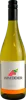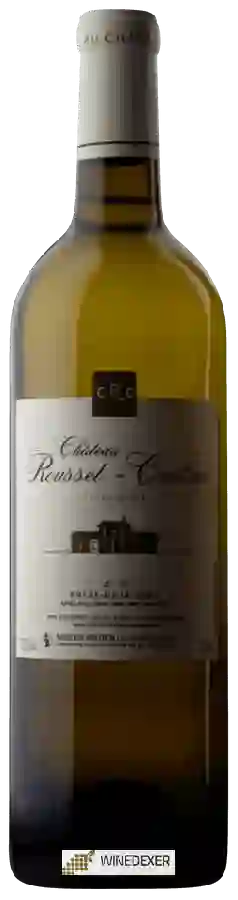
Château Rousset CaillauEntre-Deux-Mers
 White wine



This wine generally goes well with vegetarian, poultry or rich fish (salmon, tuna etc).
Food and wine pairings with Entre-Deux-Mers
Pairings that work perfectly with Entre-Deux-Mers



Original food and wine pairings with Entre-Deux-Mers


The Entre-Deux-Mers of Château Rousset Caillau matches generally quite well with dishes of rich fish (salmon, tuna etc), shellfish or sweet desserts such as recipes of hawaiian poke bowl, mussels with cream supers or gaufress and light.
Details and technical informations about Château Rousset Caillau's Entre-Deux-Mers.
Discover the grape variety: Aromella
Interspecific crossing between traminette and 34 Ravat obtained in 1976 by Bruce Reisch at the Experimental Station of Cornell University in Geneva (United States). It must be noted that this variety can only be found in a few American wine regions, which means that its multiplication is very limited. In France, it is almost unknown.
Informations about the Château Rousset Caillau
The Château Rousset Caillau is one of of the world's greatest estates. It offers 22 wines for sale in the of Entre-deux-Mers to come and discover on site or to buy online.

The wine region of Entre-deux-Mers
Entre-deux-Mers is a large wine-growing sub-region of the Bordeaux region in southwestern France. Its name literally translates as "between two seas", although the seas in question are actually rivers - the Garonne and the Dordogne, which form the southern and northern boundaries of the region respectively. The Entre-deux-Mers is home to a variety of appellations, producing wines in styles ranging from the Sweet botrytised whites of Cadillac, Loupiac and Sainte-Croix-du-Mont - all close to the northeast bank of the Garonne - to the Dry table wines of Sainte-Foy and Graves de Vayres, closer to the Dordogne. The region stretching along the Garonne from the group of sweet white wine appellations to the area east of the city of Bordeaux is the red wine appellation Côtes de Bordeaux - until 2009 called Premières Côtes de Bordeaux, a title now reserved for sweet whites.
The wine region of Bordeaux
Bordeaux, in southwestern France, is one of the most famous, prestigious and prolific wine regions in the world. The majority of Bordeaux wines (nearly 90% of the production Volume) are the Dry, medium and Full-bodied red Bordeaux blends for which it is famous. The finest (and most expensive) are the wines of the great châteaux of Haut-Médoc and the right bank appellations of Saint-Émilion and Pomerol. The former focuses (at the highest level) on Cabernet Sauvignon, the latter on Merlot.
The word of the wine: AOC
Appellation d'origine contrôlée. The most prestigious category of French wines created in the 1930s on the basis of quality criteria defined by a geographical delimitation, a chosen grape variety and precise production rules.