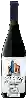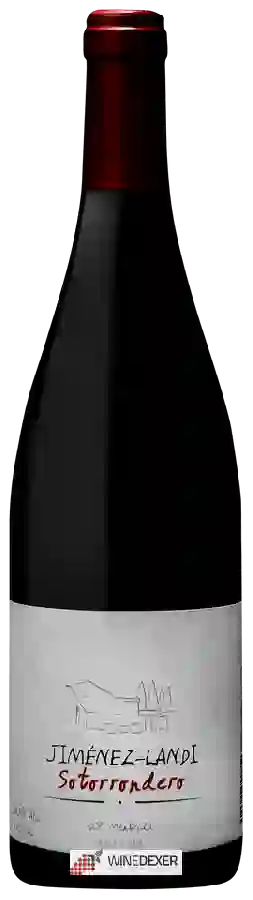
Winery Jiménez-LandiSotorrondero
 Red wine



In the mouth this red wine is a powerful with a nice freshness.
This wine generally goes well with poultry, beef or veal.
The Sotorrondero of the Winery Jiménez-Landi is in the top 10 of wines of Méntrida.

Taste structure of the Sotorrondero from the Winery Jiménez-Landi
Light | Bold | |
Smooth | Tannic | |
Dry | Sweet | |
Soft | Acidic |
In the mouth the Sotorrondero of Winery Jiménez-Landi in the region of Castille is a powerful with a nice freshness.
Wine flavors and olphactive analysis





On the nose the Sotorrondero of Winery Jiménez-Landi in the region of Castille often reveals types of flavors of cherry, oaky or smoke and sometimes also flavors of blackberry, blueberry or red fruit.
Food and wine pairings with Sotorrondero
Pairings that work perfectly with Sotorrondero



Original food and wine pairings with Sotorrondero

The Sotorrondero of Winery Jiménez-Landi matches generally quite well with dishes of beef, pasta or veal such as recipes of roast beef casserole, zucchini and goat cheese lasagna or cordon bleu with veal and cured ham.
Details and technical informations about Winery Jiménez-Landi's Sotorrondero.
Discover the grape variety: Arruffiac
Structured, lively dry whites with a pale golden colour, an elegant palate with preserved acidity and signature aromas of citrus (lemon), white flowers, stone fruits and spicy Pyrenean notes. Often blended with Gros Manseng and Petit Courbu, it contributes to the aromatic richness of Béarn and Pacherenc du Vic-Bilh AOC whites. Synonym of Arrufiac, an indigenous French white variety from the South-West.
Last vintages of this wine
The best vintages of Sotorrondero from Winery Jiménez-Landi are 2009, 2018, 2011, 2014 and 2004.
Informations about the Winery Jiménez-Landi
The Winery Jiménez-Landi is one of of the world's greatest estates. It offers 29 wines for sale in the of Méntrida to come and discover on site or to buy online.

The wine region of Méntrida
DO in northwest Toledo (Castilla-La Mancha), extreme continental climate, granitic soils, centenarian vines. Garnacha Tinta is the signature red king (>80%) in qualitative renaissance: finesse and mineral precision with red cherry, raspberry, dried flowers, herbs and pepper, silky tannins and airy transparency — compared to Pinot Noir. Tempranillo and Syrah as complements. Floral Albillo as white.
The wine region of Castille
Cradle of great Castilian reds, high-altitude plateaus (450-1000 m) along the Duero. Tempranillo king (aka Tinta de Toro, Tinto Fino): powerful, concentrated, structured reds with notes of black cherry, plum, leather, tobacco and spice, firm tannins from altitude and cool nights. Stars: Ribera del Duero (Vega Sicilia, Pingus), fleshy Toro, Bierzo (floral, mineral Mencía). Lively, herbaceous Verdejo whites from Rueda.
The word of the wine: Defect
Characteristic of a wine that is either aromatically deviant or unbalanced on the palate due to an excess or a lack of one or more flavors.